
Step-by-Step Guide to Rank in the Google Map Pack for “Near Me” Keywords

Want more calls, directions, and walk-in customers without increasing ad spend?
Ranking in the Google Map Pack for “near me” searches is one of the most powerful local SEO wins for any local business. When done right, it puts your business directly in front of high-intent users who are ready to take action.

This guide breaks down exactly how local businesses rank for “near me” keywords, using a practical, SOP-style approach you can plug straight into your local SEO workflow.

Rank Higher with Local SEO Services Company in India

Drive more foot traffic and local leads with proven SEO strategies tailored for your business.

Get Started →

Key Takeaways (Quick Summary)

If you want to rank higher for “near me” searches, focus on three things:
a fully optimized Google Business Profile, strong local relevance on your website, and consistent off-page local authority signals. Google doesn’t rank businesses just because they use the phrase “near me” — it ranks them based on relevance, proximity, and prominence.

Explore similar post covering all key “near me” ranking factors on Google Maps

How “Near Me” Searches Actually Work

One of the biggest misconceptions in local SEO is treating “near me” like a literal keyword.
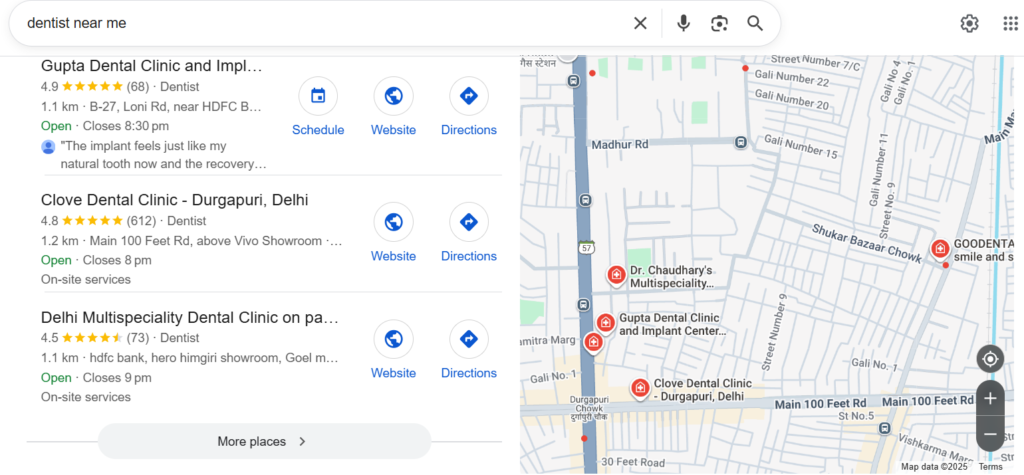
Search results for "dentist near me" on a map. Listings include Gupta Dental Clinic, Clove Dental Clinic, and Delhi Multispeciality Dental Clinic.

In reality, Google interprets “near me” as local intent combined with the user’s real-time location. This means your business doesn’t need to stuff “near me” everywhere. Instead, Google decides which businesses are:

  • Most relevant to the query
  • Closest to the searcher
  • Most prominent and trusted

These three pillars — relevance, distance, and prominence — determine who appears in the Map Pack.

Step 1: Get Your Google Business Profile Fundamentals Right

Your Google Business Profile (GBP) is the foundation of Google Maps ranking for near me keywords.

Google business profile listing for "Digi Arun," an internet marketing service in Delhi with contact info, map, photos, reviews, and hours of operation.

Start by claiming and verifying your listing. Complete every field accurately, including business name, address, phone number, website, hours, services, and attributes. Use your real business name only — adding modifiers like “best” or “near me” can trigger suspensions.

Choosing the right categories is critical. Your primary category should describe your core service precisely, while secondary categories should support additional services you genuinely offer. Categories directly influence which “near me” searches you can appear for.

Your business description and services should focus on benefits and local relevance, not keyword repetition. Phrases like “emergency plumber in Andheri, Mumbai” signal relevance far better than repeating “near me.”

Step 2: Align Your Website With Local Search Intent

Even with a strong GBP, your website plays a major role in near me search optimization.

Create dedicated location and service pages instead of forcing everything onto one generic page. A page like “Root Canal Treatment in Pune” or “24 Hour Electrician in Thane” helps Google clearly understand your service-area relevance.

On-page optimization should naturally include city or area names in title tags, headings, and key sections. Adding your NAP details in the footer and contact page — along with an embedded Google Map — strengthens location trust.

Implement LocalBusiness schema with consistent name, address, phone, geo-coordinates, and profile links. Schema alignment between your website and GBP reinforces entity accuracy and trust.

Step 3: Understand Proximity and Coverage Limits

Proximity is one of the strongest near me keyword ranking factors.

Businesses located closer to dense commercial areas usually have an advantage. Even service-area businesses should maintain a real, eligible address to compete effectively.

It’s also important to set realistic expectations. Ranking across an entire metro area is unlikely if competitors are closer to the searcher. Instead, expand visibility by building geo-specific pages and topical authority for individual neighborhoods.

Step 4: Build Strong Review and User-Generated Signals

Reviews are not just social proof — they’re a major local ranking and conversion factor.

Create a simple system to request reviews from every satisfied customer using QR codes or short links. Consistent review velocity matters more than occasional spikes.

Encourage customers to naturally mention the service and area in their feedback, such as “AC repair in Whitefield.” Respond to every review promptly, using natural language that reinforces local relevance.

Photos and videos uploaded by customers add another layer of trust and local context, strengthening your overall profile authority.

Step 5: Keep Your Google Business Profile Active

An active GBP sends strong engagement signals to Google.

Posting weekly updates about offers, FAQs, or seasonal services keeps your profile fresh. Use city and service terms naturally without spammy phrasing.

Proactively add and answer common questions in the Q&A section. This reduces friction for potential customers and improves keyword relevance.

Enable messaging and booking features wherever possible. Faster responses and easier conversions directly support better engagement metrics.

Step 6: Strengthen Off-Page Local Authority

Off-page signals help Google validate your business beyond your own properties.

Ensure consistent NAP details across major directories and platforms. Conflicting addresses or duplicate listings can weaken your local trust signals.

Local backlinks are especially powerful. Links from local news sites, bloggers, chambers of commerce, NGOs, and neighborhood organizations increase prominence.

Publishing geo-relevant content — such as neighborhood guides, case studies, or FAQs — further reinforces your service area expertise.

Step 7: Optimize for User Behavior and Experience

Ranking is only half the battle — engagement determines whether you keep that visibility.

Your Map Pack listing should encourage clicks with strong visuals, accurate attributes, and high ratings. Photos and reviews heavily influence click-through rates.

Once users land on your website, ensure fast loading, mobile-friendly design, and clear local CTAs. Click-to-call buttons, WhatsApp links, and trust indicators above the fold reduce bounce-backs to Google.

Monitor behavior metrics like calls, direction requests, and website clicks using GBP Insights to understand what’s working.

Step 8: Track, Improve, and Scale Your “Near Me” Strategy

Use grid-based local rank tracking to see how your visibility changes across neighborhoods.

Focus on real business outcomes — calls, messages, and visits — rather than rankings alone.

Refine keyword targeting using Search Console, GBP Insights, and Google’s own autocomplete suggestions. Prioritize terms with clear commercial intent.

For multi-location businesses, repeat the same structure: unique GBP profiles, localized landing pages, and area-specific content for each branch.

Final Checklist for Ranking in “Near Me” Searches

A complete and accurate Google Business Profile, locally optimized website pages with schema, steady reviews mentioning services and areas, active GBP engagement, consistent citations, and growing local authority links — this combination consistently drives Google Map Pack visibility.

Conclusion: Turning “Near Me” Visibility Into Real Customers

Ranking for “near me” keywords isn’t about tricks or keyword stuffing. It’s about aligning your location, relevance, authority, and user experience with how Google understands local intent.

When your Google Business Profile, website, and off-page signals work together, “near me” searches stop being unpredictable — they become a reliable source of calls, directions, and customers.

If you want a custom “near me” SEO strategy tailored to your business location, competition, and services, start by auditing your Google Business Profile and local pages today. Small improvements compound fast in local search — and the Map Pack rewards consistency.

FAQs – Ranking for Near Me Keywords on Google Maps

FAQs – Ranking for “Near Me” Keywords on Google Maps

1. Should I add “near me” to every title? +
No, adding “near me” to every title is not recommended and can actually hurt your SEO. Google does not rank pages for “near me” searches based on literal keyword usage. Instead, it treats “near me” as a signal of local intent and uses the searcher’s real-time location to determine results. What matters more is whether your page clearly communicates what service you offer and where you offer it.

A better approach is to use natural location modifiers such as your city, area, or neighborhood in titles and headings. For example, “Emergency Plumber in Andheri West” performs far better than forcing “near me” into a title. Google understands that users searching “plumber near me” are looking for nearby plumbers, not pages that repeat the phrase.

Use “near me” sparingly and only when it fits naturally, such as in subheadings or FAQs. Focus on relevance, clarity, and local context rather than keyword stuffing.
2. What’s the most important factor for ranking in near me searches? +
The single most important factor for ranking in “near me” searches is proximity, combined with relevance and prominence. Google prioritizes businesses that are physically close to the searcher when local intent is detected. This is why two equally optimized businesses may rank differently depending on where the user is searching from.

That said, proximity alone is not enough. Google also evaluates how relevant your Google Business Profile is to the query and how prominent your business appears online. This includes correct categories, detailed services, reviews, and consistent business information across the web.

You can’t control a user’s location, but you can optimize relevance and prominence. A well-optimized Google Business Profile, strong local website signals, and steady reviews help Google confidently show your business when proximity allows.
3. How fast can I rank in the Local Pack? +
There is no fixed timeline for ranking in the Local Pack, but most businesses see early movement within 4 to 12 weeks when the fundamentals are done correctly. New or poorly optimized listings may take longer, especially in competitive areas.

Speed depends on several factors, including competition, location density, Google Business Profile completeness, and review activity. A verified profile with accurate categories, detailed services, and consistent NAP details tends to gain visibility faster than one that is incomplete.

If your business is in a less competitive area and close to searchers, you may appear sooner. In high-competition cities, ranking usually requires ongoing optimization, reviews, and authority building. The key is consistency, not shortcuts.
4. Can I improve local SEO without paying for ads? +
Yes, local SEO can be improved significantly without spending money on ads. In fact, Google Maps and “near me” rankings are largely driven by organic factors rather than paid promotions.

Optimizing your Google Business Profile, aligning your website with local intent, collecting reviews, and maintaining NAP consistency across directories are all organic efforts. These actions help Google understand your relevance and trustworthiness without ad spend.

Ads can boost visibility temporarily, but organic local SEO builds long-term results. Many small businesses rely entirely on organic Map Pack visibility to generate calls, directions, and walk-ins. The trade-off is time and consistency rather than money.
5. Do reviews still matter in 2025? +
Yes, reviews remain one of the strongest local SEO signals in 2025. Google uses reviews to assess both prominence and trust, especially for “near me” searches where users are ready to take action.

It’s not just the number of reviews that matters, but also their quality, freshness, and engagement. Businesses with steady review activity and thoughtful responses tend to perform better than those with old or inactive profiles.

Reviews also influence click-through rates. When users see higher ratings, recent feedback, and owner responses, they are more likely to choose that business from the Map Pack. Reviews impact rankings and conversions at the same time.
6. How do voice searches affect near me SEO? +
Voice searches have a strong influence on “near me” SEO because they are often local and action-oriented. Queries like “best dentist near me” or “open pharmacy near me” are common voice searches, especially on mobile devices.

Google relies heavily on Google Business Profile data to answer voice queries. Accurate categories, hours, services, and proximity play a major role in whether your business is selected.

Optimizing for voice search means ensuring your business information is complete, up to date, and easy to understand. Clear FAQs, natural language content, and fast-loading local pages also help your business match conversational search patterns.
7. What’s the ROI of ranking for “near me” searches? +
The ROI of ranking for “near me” searches is usually very high because these users have strong purchase intent. People searching “near me” are often looking to call, visit, or book immediately.

Unlike broad SEO traffic, Map Pack clicks lead directly to actions such as phone calls, direction requests, and walk-ins. This makes “near me” rankings especially valuable for service-based and walk-in businesses.

Once you rank organically, traffic continues without ongoing ad costs. Over time, this can significantly reduce customer acquisition costs while delivering consistent leads. For many local businesses, Map Pack visibility becomes one of the most profitable marketing channels.
8. How long does it take to rank for near me searches? +
Ranking for “near me” searches typically takes between 1 to 3 months for noticeable improvement, depending on competition and optimization quality. Some businesses see quicker visibility, while others require longer-term effort.

Factors like proximity, profile completeness, review velocity, and local competition all influence timelines. Businesses closer to dense areas often see faster results, while those in crowded markets need more authority signals.

It’s important to focus on progress, not just rankings. Increases in calls, direction requests, and profile views often appear before top Map Pack positions. Local SEO is iterative, and consistent optimization delivers compounding results.
9. How can you leverage Google Trends to optimize for ‘near me’ search queries? +
Google Trends helps you understand when and how people search for services with local intent. While it doesn’t show exact “near me” volumes, it reveals seasonal patterns, rising queries, and location-based interest.

You can use it to compare service-related terms, identify peak demand periods, and discover emerging local search behavior. For example, searches for “AC repair” may spike in summer, signaling when to publish posts or update services.

Pair Google Trends insights with Google Business Profile optimization and local content updates. This allows you to align your services, posts, and offers with real user demand rather than guessing.
10. How do you analyze ‘near me’ search statistics to inform your SEO strategy? +
Analyzing “near me” performance starts with Google Business Profile Insights. Track calls, direction requests, website clicks, and peak interaction times to understand user behavior.

Google Search Console also provides valuable data by showing location-modified queries that trigger impressions. These often reflect “near me” intent even if the phrase isn’t visible.

For deeper insights, use grid-based local rank tracking tools to see how visibility changes across neighborhoods. Combine this data with on-site analytics to identify which pages and locations drive conversions. Use these insights to refine services, content, and coverage areas strategically.