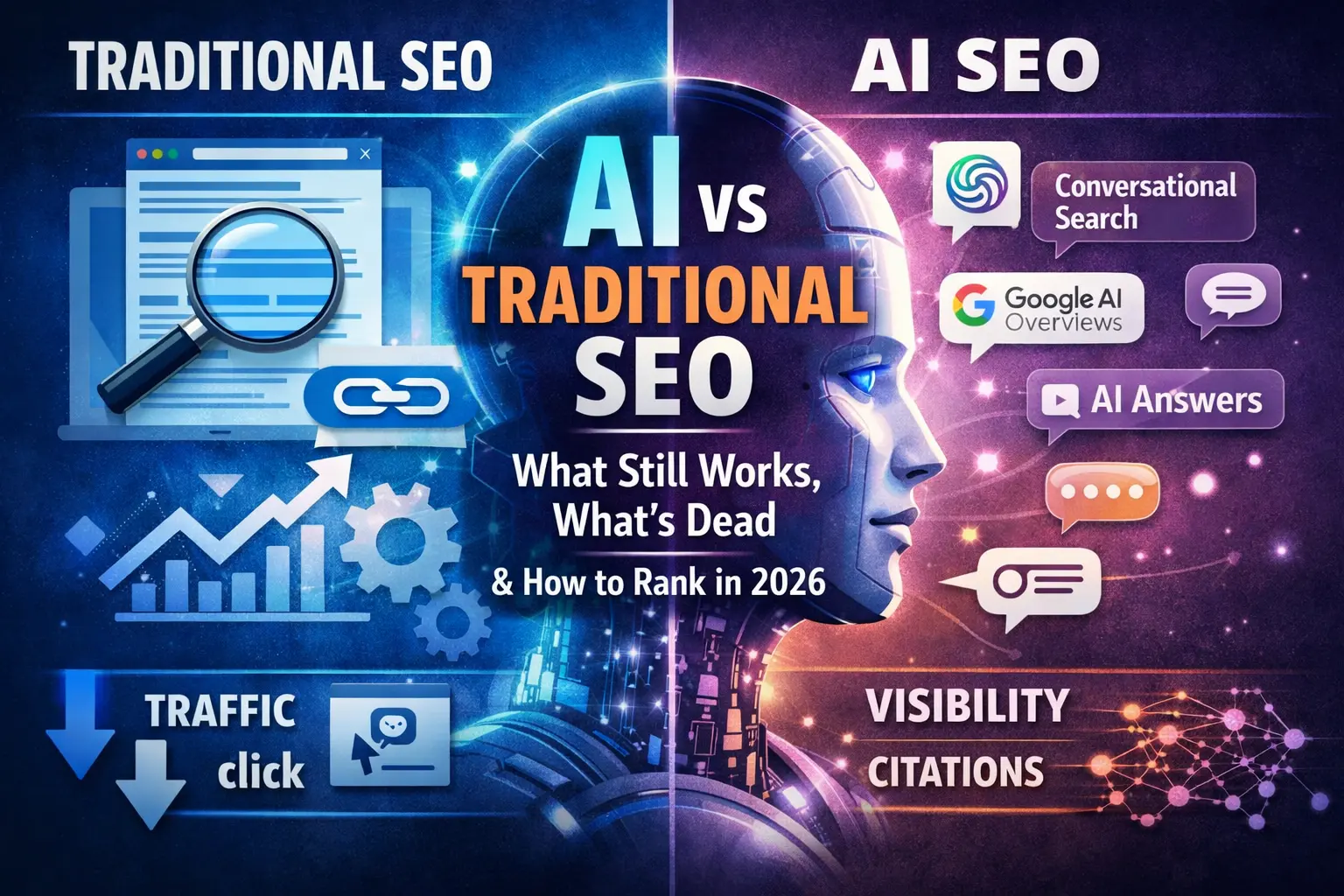

SEO is no longer just about rankings and clicks. It is about visibility across search ecosystems.
With the rise of AI-powered search systems like ChatGPT, Google’s AI Overviews, and Perplexity, users are increasingly getting answers without clicking on websites. This shift has led to declining click-through rates but stable or even improved conversions in many cases.
This change introduces a new reality:
SEO after AI is about “search presence,” not just rankings.
What Is Traditional SEO?
Traditional SEO is the process of optimizing a website to rank higher in search engine results pages (SERPs) like Google and Bing.
Key Elements of Traditional SEO
- Keywords: Targeting specific search terms users type into search engines
- Backlinks: Links from other websites that signal authority
- On-page SEO: Optimizing titles, headings, and content
- Technical SEO: Ensuring crawlability, indexing, and performance
Goal
The primary goal is to rank higher and drive clicks from search engines.
ALSO READ : SEO Guides – Complete SEO Tutorials & Strategies
What Is AI SEO (AEO / GEO)?
AI SEO (Artificial Intelligence SEO), also known as Answer Engine Optimization (AEO) or Generative Engine Optimization (GEO), focuses on optimizing content to appear in AI-generated answers.
Core Focus
- Visibility in AI tools like ChatGPT and Google AI Overviews
- Being cited or referenced instead of just clicked
- Structuring content for machine understanding
Key Concepts
- Conversational search: Users ask full questions instead of short keywords
- Prompt-based discovery: Queries are longer and more specific
AI SEO vs Traditional SEO (Side-by-Side Comparison)
| Focus Area | Traditional SEO | AI SEO |
|---|---|---|
| Discovery Model | Search results (blue links) | AI-generated answers |
| Goal | Rankings and clicks | Citations and visibility |
| Query Type | Keywords | Conversational prompts |
| Authority Signal | Backlinks | Brand mentions + trust |
| Success Metric | Traffic, CTR | AI mentions, citations |
| Audience | Humans | Humans + AI systems |
What’s DEAD in Traditional SEO (2026 Reality Check)
Some traditional practices are no longer effective in modern SEO environments.
Outdated Strategies
- Keyword stuffing: Overusing keywords reduces content quality and trust
- Writing for bots: Content that ignores user intent performs poorly
- Thin content: Low-depth content is ignored by both search engines and AI
- Over-optimized anchors: Manipulative linking patterns are less effective
- Ranking-only mindset: Rankings without visibility in AI systems limit reach
- Ignoring intent depth: Surface-level answers fail in AI-driven environments
What STILL Works (Even in AI Era)
Core SEO principles remain essential and continue to influence both traditional and AI search.
Proven Strategies
- High-quality content: Clear, accurate, and helpful information
- Backlinks (evolved): Still important for authority
- Technical SEO: Crawlability, speed, and mobile usability
- E-E-A-T signals: Experience, Expertise, Authority, Trust
- Topical authority: Deep coverage of a subject
- Internal linking: Helps structure content and distribute authority
What Has CHANGED (The Real Shift)
From Keywords → Conversations
Search behavior has shifted from short keywords to longer, natural-language queries.
- Traditional: “best seo tools”
- AI search: “what are the best SEO tools for beginners in 2026?”
From Clicks → Search Presence
SEO success now includes visibility across:
- AI-generated answers
- Google AI Overviews
- Featured snippets
- Zero-click searches
Zero click searches vs traditional searches:
Users often get answers directly without visiting a website.
From Links → Mentions & Authority
AI systems evaluate brand mentions, even without links.
- Mentions in articles, forums, and reviews contribute to credibility
- Authority is no longer limited to backlinks
From Pages → Entities
Search engines and AI systems now understand entities (people, brands, topics), not just pages.
- Entity-based SEO improves contextual relevance
- Consistent brand signals strengthen recognition
How AI Actually Reads & Uses Your Content
AI does not read content like humans. It extracts specific sections and combines them with other sources.
What AI Needs
- Clear headings
- Direct answers
- Self-contained sections
Example: Content Structure
Bad Structure:
“As discussed earlier, there are several ways to improve SEO performance…”
Good Structure:
“SEO performance depends on three factors: content quality, backlinks, and technical optimization.”
The second example works because it is clear, direct, and independent.
Technical SEO in AI Era (What You Must Do)
Technical SEO remains the foundation, but additional considerations are required for AI systems.
Core Requirements
- Crawlability and indexability
- Fast loading speed
- Mobile-friendly design
AI-Specific Optimization
- robots.txt: Allow AI crawlers
- llms.txt: Guide AI systems (emerging practice)
- Schema markup: Improve content understanding
Avoid
- Heavy JavaScript reliance (many AI crawlers cannot render it fully)
Is Link Building Dead? (Truth Revealed)
Link building is not dead, but it has evolved.
Modern Link Strategy
- Backlinks still matter
- Brand mentions are equally important
- Digital PR plays a key role
- Reviews and forums influence visibility
Key Insight:
Authority is now built through both links and mentions.
AI Content vs Human Content (What Actually Wins)
Pure AI-generated content has limitations.
Common Issues
- Low trust signals
- Lack of originality
- Repetitive insights
Winning Approach
Human + AI hybrid content
- AI assists with structure and research
- Humans add expertise, context, and originality
New SEO Metrics That Matter in 2026
Traditional metrics alone are no longer sufficient.
Updated Metrics
- AI mentions: Frequency of brand references in AI answers
- AI citations: Source attribution in responses
- Share of voice: Visibility compared to competitors
- Brand sentiment: How AI describes your brand
- Impressions vs clicks: Visibility without interaction
- Conversions: Actual business outcomes
What Happens If You Ignore AI SEO?
Ignoring AI SEO creates measurable risks.
Key Risks
- Declining organic traffic
- Reduced visibility in AI-generated answers
- Competitors dominating AI responses
- Slower growth over time
How to Adapt Your SEO Strategy for AI (Step-by-Step)
1. Write Direct Answers Under Headings
Start each section with a clear, concise answer.
2. Structure Content for Extraction
Use headings, bullet points, and short paragraphs.
3. Target Prompts, Not Just Keywords
Focus on conversational queries and user intent.
4. Build Topical Authority
Cover topics in depth rather than isolated keywords.
5. Focus on Trust Signals
Use accurate data, consistent branding, and credible sources.
6. Optimize for Both SEO and AI
Balance ranking factors with AI readability.
Future of SEO (2026–2030 Predictions)
Key Trends
- AI-driven traffic will continue to grow
- AI assistants will influence search behavior
- Search results will become more personalized
- Click-based traffic may decline further
- Visibility in AI systems will become critical
Final Verdict – AI SEO vs Traditional SEO
AI SEO is not replacing traditional SEO. It is extending it.
Key Takeaway
- Traditional SEO builds the foundation
- AI SEO expands visibility
Winning strategy:
Rank in search results + get cited in AI answers
FAQs