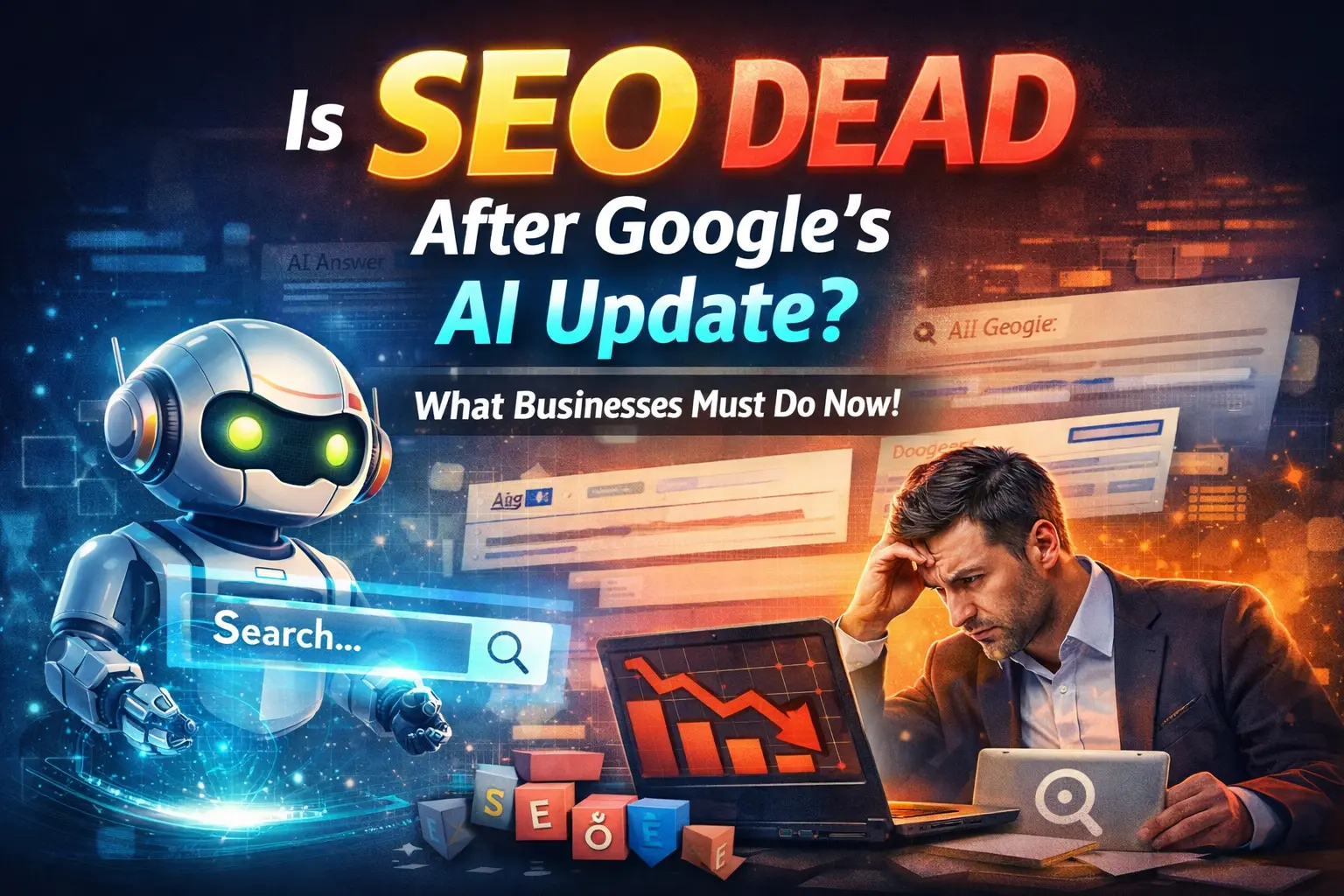

If you’ve been following recent changes in Google search, you’ve probably asked yourself this question:
“Is SEO dead?”
With AI-generated answers now appearing at the top of search results, it’s easy to feel like traditional SEO is losing its value. But the truth is more nuanced.
👉 SEO isn’t dead — it’s evolving faster than ever.
Let’s break down what’s really happening and what your business should do next.
What Changed After Google’s AI Update?
Google has introduced a new search experience where users get instant AI-generated answers (Generative AI)directly on the results page.
Instead of clicking multiple links, users can now:
- Get summarized information
- Compare products instantly
- See recommendations without leaving Google
This means:
👉 Organic results are getting pushed down
👉 Clicks may decrease for many websites
And yes, this is a big shift.
So… Is SEO Really Dead?
No. But outdated SEO is.
Old-school strategies like:
- Keyword stuffing
- Thin content
- Low-quality backlinks
👉 These are becoming irrelevant.
What’s replacing them?
👉 Trust, relevance, and real value.
Google’s AI now focuses on understanding:
- What users actually want
- Which content is most helpful
- Which sources are trustworthy
SEE ALSO: AI vs Traditional SEO: What Still Works, What’s Dead & How to Rank in 2026
Why SEO Still Matters More Than Ever
Even with AI answers, Google still needs sources to generate those answers.
That means:
👉 Your content can still be featured
👉 Your website can still gain visibility
👉 Your brand can still build authority
But only if you do it right.
What Businesses Must Do Now (Practical Strategy)
1. Focus on E-E-A-T (Not Just Keywords)
Google now prioritizes:
- Experience
- Expertise
- Authority
- Trust
👉 Write content that shows real knowledge and credibility, not just keywords.
2. Create Content That Answers Real Questions
Instead of writing for rankings, write for people’s problems.
Ask yourself:
- What is the user trying to solve?
- Can my content fully answer it?
👉 The more helpful your content, the higher your chances of being picked by AI.
3. Go Deeper, Not Broader
Thin content won’t survive anymore.
Focus on:
- Detailed guides
- Step-by-step solutions
- Real examples
👉 Become the best resource on a topic, not just another article.
4. Improve User Experience (UX)
Your website should be:
- Fast
- Mobile-friendly
- Easy to navigate
Because Google now values how users interact with your site.
5. Use Structured Data (Schema Markup)
This helps Google understand your content better.
👉 It increases your chances of:
- Featured snippets
- Rich results
- AI-generated mentions
6. Optimize for Search Intent (Not Just Keywords)
There are different types of intent:
- Informational
- Commercial
- Transactional
👉 Your content should match exactly what the user expects.
7. Build Authority in Your Niche
Instead of writing random topics:
- Focus on one niche
- Cover it deeply
- Interlink your content
👉 This builds topical authority, which AI trusts more.
The Real Shift: From Ranking to Being Chosen
Earlier, SEO was about:
👉 “How do I rank #1?”
Now, it’s about:
👉 “How do I become the best answer?”
Because AI doesn’t rank pages the same way—it selects and summarizes them.
ALSO READ: How to Rank Your Local Business First on ChatGPT & Google AI
Final Thoughts
The Google AI update is not the end of SEO.
It’s a wake-up call.
Businesses that rely on shortcuts will struggle.
But those who focus on quality, trust, and real value will grow even faster.
👉 SEO is no longer about gaming the system.
👉 It’s about genuinely helping users.
Simple Takeaway
If you remember just one thing, let it be this:
SEO isn’t dead — bad SEO is.