
If you’re looking for an established platform to publish high-quality insights on SEO, digital marketing, SaaS, B2B marketing, or local SEO, you’ve come to the right place.
At Digi Arun, we welcome experienced marketers, SEO professionals, agency owners, SaaS experts, founders, consultants, and industry practitioners who want to share practical knowledge with a global audience. Whether you have an in-depth SEO case study, a technical guide, a local SEO strategy, or actionable digital marketing insights, we’re always interested in well-researched, original content that genuinely helps readers.
Our goal isn’t simply to publish more articles—it’s to build a trusted resource where marketers can learn from real-world experiences, proven strategies, and expert perspectives. Every submission goes through an editorial review to ensure it meets our quality standards and delivers lasting value.
If you’ve been searching for seo write for us, write for us seo, seo “write for us”, write for us + seo, write for us “seo”, digital marketing “write for us”, “write for us” + seo, “write for us” seo, intitle:”write for us” saas, seo blog write for us, “write for us” “seo”, saas “write for us”, “write for us” + digital marketing, “write for us” digital marketing, seo marketing write for us, ecommerce “write for us”, saas + “write for us”, seo intitle:”write for us”, seo services write for us, “saas” + “write for us”. this page explains everything you need to know—from the topics we accept and our editorial expectations to the submission process and review timeline.
About Digi Arun
Digi Arun is a SEO Consultant in Delhi, India and a knowledge-driven platform focused on helping businesses, marketers, entrepreneurs, and SEO professionals stay ahead in an ever-evolving digital landscape. We publish practical, experience-based content covering search engine optimization, digital marketing, AI-powered search, local SEO, content marketing, B2B growth, and SaaS marketing.
Rather than chasing trends, we prioritize content that solves real problems, answers genuine user questions, and helps readers make informed marketing decisions.
Whether you’re an experienced SEO consultant, an agency professional, a SaaS marketer, or someone with valuable first-hand experience, we’d love to hear your perspective.
Our Mission
Our mission is to make advanced digital marketing knowledge more accessible through practical, actionable, and experience-driven content.
We believe the best articles don’t just explain concepts—they demonstrate how those concepts work in real situations. That’s why we encourage contributors to share lessons learned from campaigns, experiments, case studies, workflows, and measurable results whenever possible.
By publishing expert contributions, we aim to create a reliable learning hub where professionals can discover strategies they can confidently apply to their own businesses or clients.
Who Reads Digi Arun?
Our audience consists of professionals who actively work in digital marketing and are looking for actionable advice rather than introductory theory.
Our readers include:
- SEO Specialists
- Technical SEO Professionals
- Content Strategists
- Local SEO Consultants
- Digital Marketing Managers
- SaaS Founders
- B2B Marketing Teams
- Agency Owners
- Freelance Marketers
- Startup Growth Teams
- Small Business Owners
- In-house Marketing Professionals
Most visitors come to Digi Arun to find practical solutions, improve their organic visibility, learn proven marketing strategies, and stay updated with industry best practices.
Because of this, we value articles that provide original insights, step-by-step guidance, and real examples over generic advice.
Our Editorial Standards
Every article published on Digi Arun is reviewed with one goal in mind: Does this content genuinely help the reader?
We look for contributions that demonstrate expertise, thoughtful analysis, and practical experience—not content created solely to promote products or secure backlinks.
When reviewing submissions, our editorial team evaluates whether an article:
- Offers original ideas or unique perspectives
- Solves a real problem for marketers or businesses
- Includes practical examples, workflows, or case studies
- Is factually accurate and well-researched
- Uses clear, organized formatting that’s easy to follow
- Provides balanced recommendations instead of promotional claims
- Reflects current industry best practices
- Is written specifically for our audience—not copied or repurposed from another publication
Our editorial team may recommend revisions to improve clarity, accuracy, structure, or readability before publication. This collaborative process helps ensure every published article maintains a consistent standard of quality while preserving the author’s voice and expertise.
Why Write for Digi Arun?
Publishing a guest article should be about more than simply seeing your name online. It should help you share your expertise, build professional credibility, and contribute meaningful knowledge to your industry.
When you contribute to Digi Arun, you’re joining a community of marketers and SEO professionals committed to creating valuable educational content for readers around the world.
Author Exposure & Professional Byline
Every accepted article includes author attribution, allowing readers to learn more about you and your professional background. Sharing your expertise through educational content can strengthen your professional reputation and demonstrate your knowledge within your area of specialization.
Build a Portfolio of Published Work
A well-written guest article can become a valuable addition to your professional portfolio.
Whether you’re a freelance consultant, agency professional, SaaS marketer, or in-house specialist, publishing detailed, educational content showcases your ability to communicate complex topics clearly and effectively.
We particularly encourage submissions that include original research, campaign learnings, implementation strategies, or practical frameworks that readers can apply in their own work.
Reach a Highly Relevant Marketing Audience
Your content will be read by people who are actively interested in topics such as:
- Search Engine Optimization (SEO)
- Technical SEO
- Local SEO
- Digital Marketing
- Content Marketing
- SaaS Marketing
- B2B Growth
- Google Business Profile Optimization
- AI Search & Generative Search Optimization
- Conversion Rate Optimization (CRO)
- Marketing Analytics
Because our audience is highly focused, quality educational content has the opportunity to create meaningful engagement and spark valuable industry discussions.
Establish Topical Authority in Your Niche
Publishing insightful, experience-based articles helps demonstrate your expertise in your chosen field.
We especially appreciate contributions that go beyond summarizing common advice by including:
- Original frameworks
- Campaign breakdowns
- Technical implementation guides
- Lessons learned from real projects
- Industry observations
- Data-backed recommendations
- Common mistakes and how to avoid them
These types of articles provide lasting value for readers while helping establish you as a knowledgeable voice within your niche.Establish Topical Authority in Your Niche
Publishing insightful, experience-based articles helps demonstrate your expertise in your chosen field.
We especially appreciate contributions that go beyond summarizing common advice by including:
- Original frameworks
- Campaign breakdowns
- Technical implementation guides
- Lessons learned from real projects
- Industry observations
- Data-backed recommendations
- Common mistakes and how to avoid them
These types of articles provide lasting value for readers while helping establish you as a knowledgeable voice within your niche.
Connect with an Editorial Team That Values Quality
We’re committed to building long-term relationships with contributors who consistently produce thoughtful, well-researched content.
Our editorial process is collaborative rather than transactional. If your article has strong ideas but needs refinement, we’ll provide constructive feedback to help improve clarity, structure, and overall reader experience whenever appropriate.
Our objective is simple: publish content that marketers genuinely want to read, reference, and share.
Topics We Accept
We welcome original, experience-driven articles that educate, solve problems, and help marketing professionals stay ahead of industry changes. If your content offers practical advice backed by real-world experience, there’s a good chance it’s a fit for Digi Arun.
Rather than publishing surface-level listicles, we look for comprehensive resources that provide actionable takeaways, examples, frameworks, or case studies readers can immediately apply.
Below are the primary topics we actively accept.
SEO & Search Engine Optimization
Search is constantly evolving, and we’re interested in content that helps businesses and marketers improve their visibility through sustainable, user-focused strategies.
Technical SEO
Examples include:
- Website crawling and indexing
- XML sitemaps
- Robots.txt optimization
- Core Web Vitals
- Page speed optimization
- JavaScript SEO
- Canonicalization
- Structured data
- Schema implementation
- Mobile-first indexing
- International SEO
- Log file analysis
On-Page SEO
We’re interested in practical content covering:
- Keyword research methodologies
- Search intent optimization
- Content optimization
- Semantic SEO
- Topical authority
- Internal linking strategies
- Content clusters
- Entity optimization
- Meta titles and descriptions
- Heading hierarchy
- Image SEO
- URL optimization
Off-Page SEO & Link Building
Topics may include:
- White-hat link building
- Digital PR
- Guest blogging strategies
- Editorial backlinks
- Broken link building
- Resource page outreach
- HARO alternatives
- Brand mentions
- Outreach campaigns
- Link audits
- Toxic backlink management
Local SEO
We actively welcome content about:
- Google Business Profile optimization
- Local keyword research
- Citation management
- Local landing pages
- Multi-location SEO
- Local link building
- Review management
- Local ranking factors
- Map Pack optimization
- Service-area businesses
SEO Case Studies
One of our favorite content formats is a detailed case study.
Share insights such as:
- Organic traffic growth
- Ranking improvements
- Technical SEO recoveries
- Migration projects
- Local SEO campaigns
- Content strategy results
- Link-building experiments
- AI search optimization experiences
Whenever possible, include screenshots, timelines, measurable outcomes, and lessons learned.
AI Search & Emerging Search Technologies
We encourage articles covering:
- AI-powered search experiences
- Generative search optimization
- AI Overviews
- AI content workflows
- Retrieval optimization
- Search behavior changes
- Entity-first SEO
- Search experience optimization
- Prompt-driven content research
Digital Marketing
Digital marketing extends well beyond SEO. We publish practical strategies that help businesses attract, engage, and retain customers across multiple channels.
Content Marketing
Topics include:
- Content strategy
- Editorial planning
- Topic clusters
- Content refresh strategies
- Thought leadership
- Content distribution
- Evergreen content
- Content audits
- Audience research
PPC & Paid Advertising
We’re interested in:
- Google Ads
- Microsoft Ads
- Performance Max
- Paid search optimization
- Landing page optimization
- Campaign structure
- Budget management
- ROI improvement
- Attribution
Email Marketing
Suggested topics include:
- Email automation
- Newsletter strategy
- Customer segmentation
- Personalization
- Lead nurturing
- Lifecycle campaigns
- Deliverability
- Email analytics
Social Media Marketing
We welcome practical articles about:
- LinkedIn marketing
- Facebook marketing
- Instagram strategy
- YouTube growth
- Social content planning
- Community building
- Organic social strategy
- Short-form video marketing
Conversion Rate Optimization (CRO)
Potential topics:
- Landing page optimization
- User behavior analysis
- Heatmaps
- A/B testing
- User journeys
- Sales funnels
- Conversion psychology
- Lead generation
Marketing Analytics
Share expertise on:
- Google Analytics
- Google Tag Manager
- Looker Studio
- Attribution models
- KPI dashboards
- Marketing reporting
- Customer insights
- Performance measurement
SaaS & B2B Marketing
We’re always looking for contributors with hands-on experience growing SaaS businesses or B2B brands.
SaaS Content Strategy
Topics include:
- SaaS SEO
- Product marketing
- Documentation strategy
- Feature pages
- Comparison pages
- Bottom-of-funnel content
- Customer education
- Content-led growth
Product-Led Growth (PLG)
We welcome insights into:
- User onboarding
- Product adoption
- Free trial optimization
- Activation metrics
- Retention strategies
- Expansion revenue
- Customer success
B2B Lead Generation
Suggested areas:
- Demand generation
- Lead nurturing
- Sales enablement
- Pipeline growth
- Buyer journey optimization
- Lead qualification
- Marketing automation
Customer Retention & Lifecycle Marketing
Share expertise on:
- Customer retention
- Churn reduction
- Customer engagement
- Lifecycle campaigns
- Upselling
- Cross-selling
- Customer loyalty
AI Tools for SaaS Marketing
We also accept practical reviews and implementation guides covering:
- AI marketing tools
- Workflow automation
- AI-powered analytics
- CRM automation
- Sales intelligence
- Marketing productivity
B2B & Enterprise Marketing
If you’ve worked with enterprise organizations or B2B businesses, we’d love to hear your insights.
Topics include:
Account-Based Marketing (ABM)
- Target account strategies
- Personalized campaigns
- Sales alignment
- Enterprise outreach
Sales & Marketing Alignment
Cover areas such as:
- Revenue operations
- CRM workflows
- Marketing-qualified leads
- Sales-qualified leads
- Pipeline optimization
Enterprise SEO
Examples include:
- Large website management
- International SEO
- Multi-domain strategies
- Enterprise content governance
- Technical SEO at scale
B2B Branding
Topics may include:
- Brand positioning
- Market differentiation
- Thought leadership
- Brand awareness
- Industry authority
Local SEO & Google Business Profile
Local businesses face unique search challenges, making this one of our priority content categories.
Examples include:
Google Business Profile Optimization
- Listing optimization
- Categories
- Services
- Products
- Reviews
- Posts
- Q&A management
Local Citations
Write about:
- Citation audits
- NAP consistency
- Directory management
- Citation cleanup
Local Link Building
Potential ideas:
- Community partnerships
- Local sponsorships
- Chamber of Commerce links
- Local PR
Multi-Location SEO
Share practical guidance on:
- Franchise SEO
- Multi-location architecture
- Local landing pages
- Location management
Topics We Don’t Accept
To maintain editorial quality and ensure every article provides genuine value, we do not publish content that falls into the following categories.
| We Accept | We Don’t Accept |
|---|---|
| Original research | Duplicate or republished content |
| Practical tutorials | Thin articles with little educational value |
| Case studies | AI-generated content without human editing |
| Educational guides | Keyword-stuffed articles |
| Industry insights | Promotional sales copy |
| Experience-based advice | Affiliate-heavy content |
| Data-backed analysis | Misleading or inaccurate information |
| Helpful comparisons | Plagiarized content |
| Ethical SEO strategies | Manipulative SEO tactics |
| Well-supported opinions | Unverified claims presented as facts |
We also reject submissions related to:
- Gambling
- Betting
- Adult content
- Illegal activities
- Cryptocurrency scams
- Hate speech
- Discriminatory content
- Malware or hacking tutorials
- Medical or legal advice outside verified expertise
Our editorial team reserves the right to decline any submission that doesn’t align with our content standards or audience expectations.
Guest Post Guidelines
Following these guidelines improves the chances of your submission moving smoothly through our editorial review process.
Word Count & Content Depth
We recommend articles between 1,200 and 2,000+ words, depending on the topic.
Rather than focusing on a specific word count, prioritize depth, clarity, and completeness.
A strong article should:
- Answer the primary question thoroughly
- Cover related subtopics naturally
- Include actionable advice
- Provide examples where appropriate
- Leave readers with practical next steps
Originality & Plagiarism Policy
Every submission must be 100% original.
We do not accept:
- Previously published articles
- Duplicate content
- Spun content
- AI-paraphrased copies
- Content submitted simultaneously to multiple websites
If you reference external sources, cite them appropriately and add your own analysis or interpretation rather than simply summarizing existing content.
Formatting & Structure Requirements
For the best reading experience, please follow these formatting standards:
- Use clear H2, H3, and H4 headings.
- Keep paragraphs short and easy to scan.
- Use bullet points where appropriate.
- Include numbered steps for tutorials.
- Add comparison tables when they improve understanding.
- Use descriptive headings instead of generic titles.
- Maintain a logical flow from one section to the next.
Well-structured content is easier for readers to navigate and helps communicate ideas more effectively.
Internal & External Linking Guidelines
You may include relevant references that genuinely enhance the reader’s understanding.
When adding links:
- Use descriptive anchor text.
- Only link to reputable, trustworthy resources.
- Avoid excessive self-promotional links.
- Ensure every external reference supports the content.
- Link naturally rather than forcing references into the article.
Our editorial team may adjust, replace, or remove links that don’t meet our quality standards.
Images & Visual Content
Original visuals can significantly improve an article.
If including images:
- Use high-resolution screenshots or graphics.
- Ensure you have permission to use all visuals.
- Include descriptive captions where helpful.
- Provide meaningful alt text when applicable.
- Avoid copyrighted material without authorization.
Charts, diagrams, workflow illustrations, and annotated screenshots are particularly valuable for technical content.
Sources & Citations
Support factual claims with reliable sources whenever possible.
Examples include:
- Official documentation
- Industry research
- Government publications
- Academic studies
- Original data
- Reputable industry reports
Where appropriate, explain how the findings relate to your own experience or recommendations.
Tone of Voice
We publish content written for professionals.
Your writing should be:
- Helpful
- Clear
- Practical
- Honest
- Evidence-based
- Conversational
- Respectful
Avoid unnecessary jargon, exaggerated marketing language, or unsupported claims.
Write as if you’re sharing advice with a knowledgeable colleague.
AI-Assisted Content Policy
We understand that many writers use AI-powered tools to assist with research, outlining, grammar, or editing.
However, every submission must ultimately reflect human expertise, critical thinking, and editorial judgment.
Before submitting, ensure that your article:
- Has been thoroughly reviewed and edited by a human.
- Includes original insights or practical experience.
- Contains accurate, up-to-date information.
- Uses natural, reader-friendly language.
- Is free from repetitive or generic AI-generated phrasing.
Submissions that appear to be entirely machine-generated without meaningful human contribution are unlikely to be accepted.
Grammar & Readability Standards
Before submitting your article, take time to proofread it carefully.
A high-quality submission should feature:
- Correct grammar and spelling
- Consistent formatting
- Clear sentence structure
- Logical organization
- Smooth transitions between sections
- Accurate terminology
- Readable formatting across desktop and mobile devices
Well-edited articles create a better experience for readers and reduce the need for extensive editorial revisions.
SEO Guidelines for Contributors
Great content deserves to be discoverable, useful, and trustworthy. Before submitting your article, take a few extra minutes to ensure it follows these SEO best practices. They not only improve readability but also help create a better experience for our audience.
Our goal is to publish content that remains valuable long after it’s published—not articles written solely to target keywords.
Keyword Usage & Semantic Optimization
Keywords help readers and search engines understand your topic, but they should always fit naturally within the content.
When writing your article:
- Focus on one primary topic throughout the article.
- Use your primary keyword naturally in the title, introduction, headings, and conclusion where appropriate.
- Incorporate related terms and supporting concepts instead of repeating the same keyword excessively.
- Write for user intent first—every section should answer a specific question or solve a real problem.
- Include definitions, examples, comparisons, and practical advice to make the article comprehensive.
Best Practices
✔ Write naturally for humans.
✔ Cover the topic in depth instead of chasing keyword density.
✔ Use descriptive headings that accurately reflect the content.
✔ Include related terminology that readers would expect to see.
Avoid
- Keyword stuffing
- Forced exact-match phrases
- Repetitive headings
- Writing solely to rank rather than educate
Experience, Expertise, Authoritativeness & Trust (E-E-A-T)
Readers trust content written by people who have practical experience.
Whenever possible, support your recommendations with:
- Real campaign experiences
- Case studies
- Performance data
- Screenshots
- Original research
- Industry observations
- Lessons learned from failures as well as successes
Instead of saying:
“Link building is important.”
Explain why, how, and what happened when you implemented a specific strategy.
For example:
- How you increased organic traffic after improving internal linking.
- Lessons learned during a website migration.
- Local SEO improvements achieved through Google Business Profile optimization.
- Technical SEO issues discovered during a site audit.
- Results from optimizing Core Web Vitals.
Articles grounded in genuine experience provide significantly more value than theoretical advice alone.
Internal Linking & Anchor Text Guidelines
Internal links help readers discover related resources while improving the overall structure of our website.
Where relevant, link naturally to existing Digi Arun articles that expand on the topic you’re discussing.
Examples include:
- Related SEO guides
- Technical SEO tutorials
- Local SEO resources
- Digital marketing articles
- SaaS marketing content
- Case studies
When creating anchor text:
✔ Make it descriptive.
✔ Explain what readers can expect after clicking.
✔ Keep it relevant to the surrounding content.
Examples of good anchor text:
- Local SEO checklist
- Technical SEO audit guide
- Beginner’s guide to schema markup
- Google Business Profile optimization tips
Avoid:
- “Click here”
- “Read more”
- Overusing exact-match keyword anchors
- Linking every paragraph unnecessarily
Quality always matters more than quantity.
Meta Title & Meta Description Recommendations
Although our editorial team may refine metadata before publication, contributors are encouraged to suggest a meta title and description with every submission.
Meta Title
Aim for:
- Approximately 50–60 characters
- Clear description of the topic
- Natural inclusion of the primary keyword
- Compelling wording that encourages clicks
Example:
Technical SEO Checklist: A Step-by-Step Guide for 2026
Align with Helpful Content Standards
The best-performing articles are those that fully answer a reader’s question without unnecessary filler.
Before submitting your draft, ask yourself:
- Does this article solve a real problem?
- Is every section genuinely useful?
- Have I explained concepts clearly?
- Have I added something original?
- Would I bookmark or recommend this article?
Strong submissions typically include:
- Practical examples
- Actionable advice
- Step-by-step instructions
- Decision-making frameworks
- Comparison tables
- Checklists
- Frequently asked questions
- Common mistakes to avoid
Our goal is to publish content that readers can confidently reference, share, and return to over time.
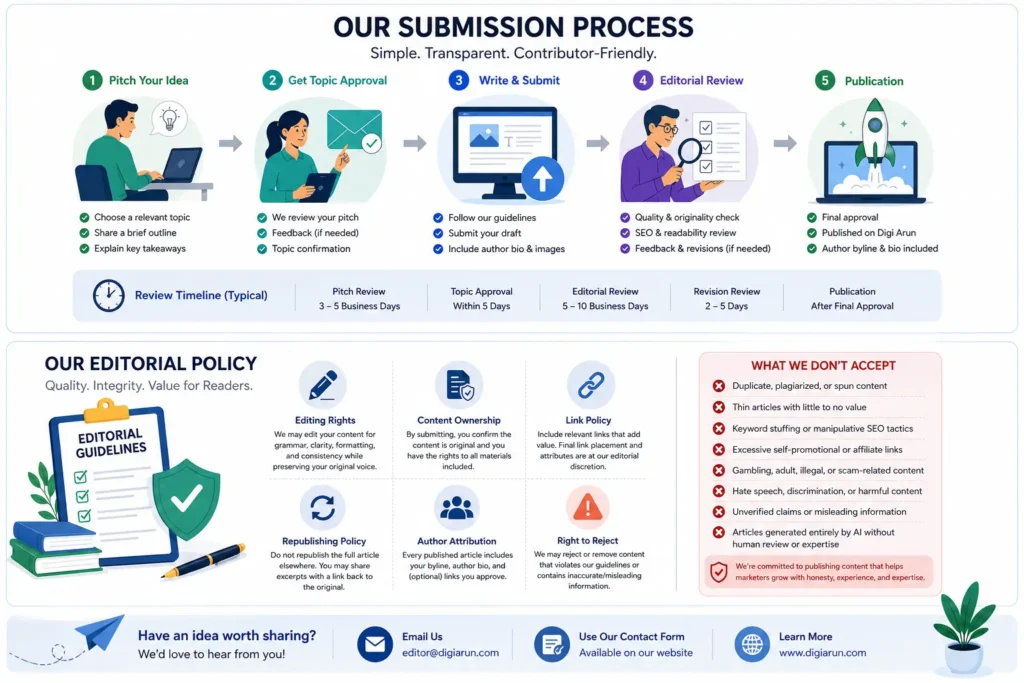
Submission Process
We’ve designed our submission process to be straightforward and transparent. Following the steps below helps us review your proposal efficiently while ensuring every article meets our editorial standards.
Step 1 — Pitch Your Topic
Before writing a complete article, send us your proposed topic.
Your pitch should briefly explain:
- What you plan to write about
- Why the topic matters
- The primary audience
- The key takeaways readers will gain
- Why you’re qualified to write on the subject
A concise, well-thought-out pitch helps us determine whether the topic aligns with our editorial calendar and avoids duplicate content.
Step 2 — Receive Editorial Approval
Our editorial team reviews each proposal based on factors such as:
- Relevance to our audience
- Originality
- Depth of the proposed topic
- Current industry trends
- Existing content on Digi Arun
If your idea is a good fit, we’ll confirm the topic and may suggest adjustments to improve its focus or expand its scope before you begin writing.
Step 3 — Write & Submit Your Draft
Once your topic is approved, prepare your article according to our editorial guidelines.
Please include:
- The completed article (Google Docs or Microsoft Word preferred)
- Suggested meta title
- Suggested meta description
- Relevant images or screenshots (if applicable)
- Proper source citations
- A short author bio (50–100 words)
- Links to your professional website or LinkedIn profile (optional)
Before submitting, proofread your article carefully to ensure it is accurate, well-structured, and free from grammatical errors.
Step 4 — Editorial Review
Every submission undergoes a comprehensive editorial review.
During this process, we evaluate:
- Content quality
- Accuracy of information
- Originality
- Readability
- Structure and formatting
- Relevance to our audience
- Supporting evidence and examples
If revisions are needed, we’ll share constructive feedback. Minor edits may be made by our editorial team to improve grammar, formatting, clarity, or consistency while preserving your original ideas and voice.
Step 5 — Publication
After your article has been approved, it will be scheduled for publication.
Before publishing, we conduct a final quality check to ensure:
- Formatting is consistent.
- Links are working correctly.
- Images display properly.
- Sources are appropriately credited.
- The article provides a smooth reading experience across devices.
Once published, your contribution will include your author byline and approved author bio.
Review Timeline
We understand contributors appreciate clear expectations. While timelines may vary depending on editorial workload and submission volume, we aim to review every submission as efficiently as possible.
| Stage | Typical Timeline |
|---|---|
| Initial Pitch Review | 3–5 business days |
| Topic Approval | Within 5 business days |
| Editorial Review | 5–10 business days |
| Revision Review | 2–5 business days after resubmission |
| Publication | Based on our editorial calendar after final approval |
If additional revisions are required or submissions are received during particularly busy periods, review times may be slightly longer. We appreciate your patience throughout the process.
Editorial Policy
Maintaining consistent editorial standards helps us provide readers with trustworthy, high-quality content. The following policies explain how submissions are handled after acceptance.
Editing Rights
Our editorial team reserves the right to edit accepted submissions for:
- Grammar and spelling
- Clarity
- Formatting
- Readability
- Consistency
- Style alignment
These edits are intended to improve the reader experience without changing the author’s original intent.
Content Ownership & Usage
By submitting an article to Digi Arun, you confirm that the work is your original creation and that you have the necessary rights to all text, images, charts, and other materials included in your submission.
Accepted articles are published with appropriate author attribution. Authors should not submit material that infringes on copyright or third-party intellectual property.
Republishing & Syndication Policy
To maintain the originality and value of our content library, accepted guest posts should remain exclusive to Digi Arun.
Please do not republish the full article on another website after publication.
You are welcome to:
- Share the published article on social media.
- Include the publication in your professional portfolio.
- Publish a short summary that links back to the original article.
If you’d like to republish or syndicate the content elsewhere, please contact our editorial team in advance.
Link Policy
We encourage contributors to include links that genuinely enhance the reader’s understanding of the topic.
Please keep the following in mind:
- Links should be directly relevant to the content.
- Every external reference must provide additional value.
- Excessive promotional links may be removed.
- Affiliate links, tracking links, shortened URLs, or misleading redirects are not permitted.
- Final link placement and attributes are determined by our editorial team.
Our priority is maintaining a trustworthy reading experience while ensuring links remain useful, contextual, and editorially appropriate.
Grounds for Rejection or Removal
Submissions may be rejected—or, in exceptional cases, removed after publication—if they violate our editorial standards.
Common reasons include:
- Plagiarized or duplicated content
- Copyright infringement
- Factually inaccurate information
- Spammy or manipulative linking practices
- Undisclosed AI-generated content with little or no human editing
- Misleading claims
- Poor readability or excessive promotional language
- Content that no longer aligns with our editorial policies
Our objective is not simply to publish more articles, but to maintain a high-quality resource that readers can trust.
How to Submit Your Guest Post
Ready to contribute? We’d love to hear your ideas.
Submission Email
Please send your pitch or completed article to our editorial team using the email address (writeforus@digiarun.com).
Subject Line Recommendation
Guest Post Submission – [Your Proposed Article Title]
Using a clear subject line helps us review and organize submissions more efficiently.
What to Include in Your Pitch
To help us review your proposal quickly, include the following information:
- Your proposed article title
- A brief summary of the topic (2–4 sentences)
- Why the topic is valuable for our audience
- A short outline (optional but recommended)
- Links to previously published work or writing samples
- Your professional website or portfolio (if available)
- LinkedIn profile (optional)
- Any relevant industry experience or credentials
Providing complete information upfront helps streamline the review process and allows our editorial team to evaluate your submission more efficiently.
Frequently Asked Questions
What does “Write for Us” mean for an SEO or digital marketing blog?
A “Write for Us” page invites industry professionals to contribute original articles to our blog. If you have expertise in SEO, digital marketing, SaaS, B2B marketing, or local SEO, you can pitch a topic that provides practical value to our readers.
Does Digi Arun accept SEO guest posts?
Yes. We actively accept high-quality guest posts covering technical SEO, on-page SEO, off-page SEO, local SEO, enterprise SEO, AI-powered search, content strategy, SEO case studies, and other search-related topics.
Do you accept guest posts about SaaS and B2B marketing?
Absolutely.
We’re always interested in practical articles covering:
- SaaS marketing
- Product-led growth (PLG)
- B2B SEO
- Demand generation
- Lead generation
- Customer retention
- Marketing automation
- Enterprise marketing
- Revenue growth strategies
What is the minimum word count for a guest post?
We generally recommend articles between 1,200 and 2,000+ words.
Rather than focusing solely on length, we prioritize depth, originality, and usefulness. A comprehensive article that fully answers the reader’s questions will always be preferred over a shorter, surface-level piece.
Can I include backlinks in my guest post?
Yes, where they genuinely add value to readers.
Links should be:
- Relevant
- Contextual
- Educational
- Non-promotional
Our editorial team reviews every link and may modify or remove those that don’t align with our editorial standards.
How many links can I include?
There’s no fixed number.
Instead of counting links, we evaluate whether each one improves the reader’s understanding. Excessive or promotional linking may result in revisions before publication.
How long does it take to receive a response?
We typically acknowledge and review new pitches within 3–5 business days. During periods of high submission volume, response times may vary slightly.
How long does the editorial review take?
Most approved drafts are reviewed within 5–10 business days. If revisions are required, publication timelines depend on how quickly updated drafts are submitted.
Do you accept articles about Local SEO?
Yes.
We’re particularly interested in topics such as:
- Google Business Profile optimization
- Local citations
- Local ranking factors
- Multi-location SEO
- Local link building
- Review management
- Hyperlocal content strategy
What topics are not accepted?
We don’t publish:
- Duplicate content
- Thin articles
- Promotional sales copy
- Gambling or betting content
- Adult content
- Copyright-infringing material
- Spammy SEO tactics
- Plagiarized content
- Keyword-stuffed articles
- Articles lacking practical value
Can I republish my article elsewhere after it’s published?
To preserve content originality, we ask contributors not to republish the complete article on another website after publication.
You’re welcome to share excerpts, summaries, or social media posts that link back to the original article.
Do you accept SEO case studies or original research?
Yes.
In fact, these are among our favorite submissions.
We’re particularly interested in articles featuring:
- Real campaign results
- Data-driven insights
- Before-and-after comparisons
- Performance metrics
- Lessons learned
- Practical implementation details
Can beginners contribute?
Yes.
While industry experience is valuable, we welcome contributions from first-time writers who can provide accurate, well-researched, and genuinely helpful content.
Strong writing and useful insights matter more than years of experience.
Do I need to be an SEO expert?
Not necessarily.
We also welcome professionals specializing in:
- Digital marketing
- SaaS
- B2B marketing
- Content marketing
- Email marketing
- PPC
- Analytics
- Conversion optimization
- Marketing technology
As long as your article demonstrates expertise and provides value, we’d be happy to review it.
How should I pitch a topic?
Start with a short email introducing yourself and your proposed article.
Include:
- Working title
- Brief summary
- Why it’s relevant
- Your experience with the topic
- Previous writing samples (if available)
A clear, focused pitch helps us review your proposal more efficiently.
What formatting do you require?
For the best reader experience, please use:
- Clear heading hierarchy (H2–H4)
- Short paragraphs
- Bullet lists
- Tables where appropriate
- Numbered steps for tutorials
- Proper source citations
- Relevant screenshots or visuals (when applicable)
Do you accept articles about PPC, Email Marketing, and Content Marketing? Yes.
We’re interested in practical articles covering a wide range of digital marketing disciplines, including paid advertising, email automation, content strategy, marketing analytics, and conversion optimization.
Do you accept B2B and enterprise marketing content?
Absolutely.
Topics such as account-based marketing (ABM), enterprise SEO, demand generation, marketing operations, customer lifecycle marketing, and B2B growth strategies are all within our editorial scope.
What happens if my submission isn’t accepted?
Not every article is the right fit for our audience.
If your submission isn’t approved, it may be due to reasons such as:
- Topic overlap
- Limited originality
- Insufficient depth
- Editorial quality
- Audience relevance
Whenever possible, we’ll provide feedback to help you improve future submissions.
Can I include screenshots, charts, or original graphics?
Yes.
Original visuals are encouraged because they often make complex topics easier to understand.
Please ensure you own the rights to any images you submit and provide appropriate attribution where necessary.
How do I contact the editorial team?
You can reach us through the submission email address (writeforus@digiarun.com) listed above.
When contacting us, include enough information about your proposed article so we can evaluate it quickly and provide an informed response.
Ready to Contribute? Submit Your Pitch Today
If you’re passionate about SEO, digital marketing, SaaS, B2B marketing, or local SEO and have actionable insights to share, we’d love to hear from you.
Before submitting, take a moment to review our editorial guidelines, ensure your content is original, and focus on delivering practical value that helps our readers solve real-world challenges.
Whether you’re sharing a detailed case study, a technical tutorial, a proven marketing framework, or lessons learned from hands-on experience, your expertise could help thousands of marketers make better decisions.
Ready to get started?
Send us your topic idea, a short outline, and a brief introduction. Our editorial team will review your submission and get back to you as soon as possible.
We look forward to collaborating with knowledgeable contributors who are committed to publishing thoughtful, high-quality content.