

Last Updated on 3 weeks ago by Arun Kumar
India’s Digital Personal Data Protection framework is changing the way marketing teams need to think about customer data.
The biggest change is not that businesses have to stop digital marketing, analytics or advertising.
It is that marketers need to understand what personal data they collect, why they collect it, where it moves, which tools receive it, and what happens when a person changes their choice.
For a modern marketing team, that can involve much more than a privacy policy.
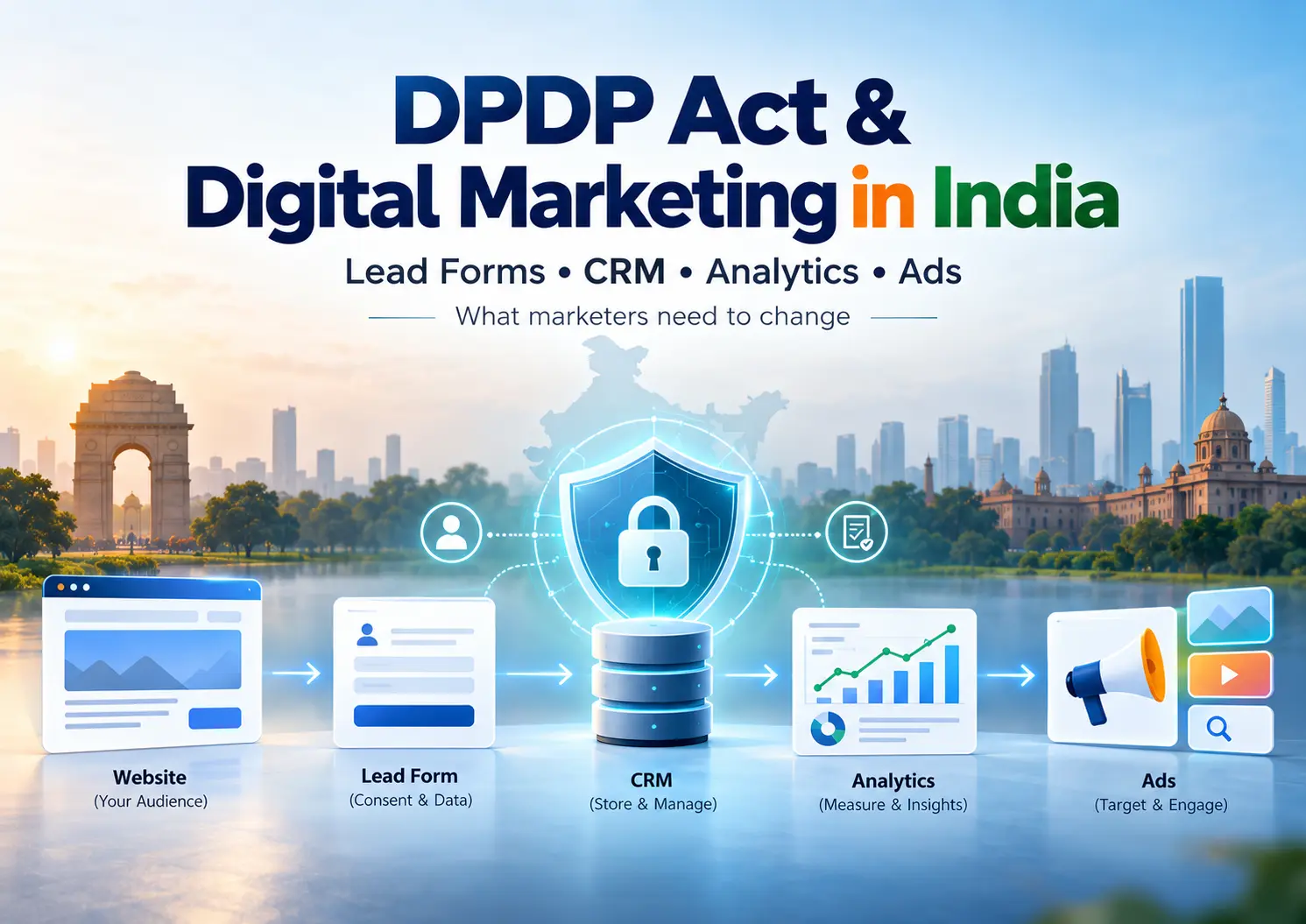
A single website lead may move through a form, CRM, sales team, email automation platform, advertising audience and analytics system.
That is why DPDP readiness should be treated as a marketing-data workflow problem, not simply a cookie-banner exercise.
Quick takeaway: Marketing teams should start mapping the complete customer-data journey—collection, transfer, storage, activation, measurement and withdrawal—and review each stage against the applicable DPDP requirements.
Important: This article is intended for general awareness and marketing planning. It is not legal advice. The DPDP Act and Rules use phased commencement, so businesses should verify which provisions apply at the relevant date and seek appropriate legal advice for their specific processing activities.
What Is the DPDP Act?
The Digital Personal Data Protection Act, 2023 creates India’s framework for processing digital personal data.
For marketers, important concepts include:
- personal data;
- Data Principal;
- Data Fiduciary;
- Data Processor;
- consent;
- notice;
- specified purpose;
- withdrawal of consent;
- security safeguards; and
- individual rights.
A marketer may encounter personal data almost immediately when someone fills in a contact form, registers for an account, subscribes to an email list or becomes a customer.
The marketing question is therefore not simply:
“Are we collecting data?”
A better set of questions is:
- What are we collecting?
- Why do we need it?
- What did we tell the person?
- Where does the information go next?
- Which third parties receive it?
- How long is it needed?
- What happens if the user withdraws consent where consent is the basis for processing?
DPDP Timeline: Do Not Treat 2026 as One Universal Compliance Date
The DPDP Act was enacted in 2023, while the Digital Personal Data Protection Rules, 2025 were notified in November 2025.
However, the framework uses phased commencement.
This matters because marketers may encounter articles saying the law is simply “effective in 2026” or that every substantive obligation already applies at the same time.
That oversimplifies the implementation timeline.
Marketing teams should therefore prepare their systems now while verifying the commencement date of the particular legal obligation they are relying on.
Where Does Personal Data Enter a Marketing Stack?
The easiest way to understand DPDP from a marketing perspective is to follow customer data.
A typical journey may look like:
Website visitor → lead form → CRM → sales team → email automation → advertising platform → analytics
Personal data may enter through:
- contact forms;
- newsletter subscriptions;
- demo requests;
- ecommerce checkouts;
- registrations;
- webinars;
- chatbots;
- WhatsApp enquiries;
- offline lead capture;
- CRM imports;
- customer-support interactions; or
- advertising lead forms.
The important point is that the information rarely stays where it was originally collected.
A phone number entered on a website may later appear in a CRM.
An email address may enter an automated campaign.
A customer record may be synced with an advertising platform.
A website interaction may generate analytics or advertising signals.
This is why marketing teams need a data-flow map, not simply a list of installed tools.
How DPDP Changes the Way Marketers Should Think About Consent
Consent should not be treated as an invisible sentence inside a long privacy policy.
Marketing teams need to understand the relationship between:
Data collected → purpose → user information/notice → processing
Suppose someone submits a form to request an SEO consultation.
The immediate purpose is straightforward: respond to the consultation request.
But that does not automatically answer every future question about:
- newsletters;
- unrelated promotional campaigns;
- advertising audience creation;
- profiling;
- cross-selling; or
- other new uses.
The more useful question for marketers is:
Does the proposed use match the purpose and applicable basis under which the information was obtained?
That mindset prevents “one interaction means permission for everything” from becoming the default marketing architecture.
How to Review Website Forms for DPDP Readiness
Start with every form on the website.
For each field ask:
- What information are we asking for?
- Why is that field needed?
- Is it necessary for the stated purpose?
- Is the purpose explained clearly?
- Where does the submitted information go?
- Which integrations receive it?
- Is it later used for another purpose?
- How would a user exercise the relevant choice or right?
Consider a consultation form asking for:
- name;
- email;
- phone;
- company;
- designation;
- city;
- budget;
- revenue;
- service requirement; and
- detailed business information.
The fact that your CRM supports 20 fields does not mean the form needs all 20.
A better design starts with the business need.
For example:
Submit your details so we can respond to your SEO consultation request.
Then collect information genuinely needed to fulfil that request.
Any additional marketing use should be separately reviewed rather than assumed from the service enquiry.
DPDP, Google Analytics and Website Tracking
Analytics remains an important part of digital marketing.
The DPDP framework does not mean businesses should automatically stop measuring website performance.
Instead, marketers need to understand their implementation.
Audit:
- Google Analytics;
- Google Tag Manager;
- Google Ads conversion tags;
- Meta Pixel;
- heatmaps;
- chat widgets;
- call-tracking scripts;
- session-recording software;
- embedded third-party tools; and
- other advertising or measurement tags.
For every tool document:
- what it collects;
- why it is installed;
- who receives the information;
- whether personal data is involved;
- which user preference or consent mechanism applies;
- how the tag behaves after that choice; and
- whether the tool is still necessary.
What About Google Consent Mode?
Google Consent Mode can communicate consent states to Google tags and change how supported Google products behave.
It should not be described as a “DPDP compliance switch.”
A business is still responsible for determining the appropriate consent and data-processing approach for its own implementation.
The useful technical principle is:
Your frontend consent experience and backend/tag behaviour should agree.
If a user selects one preference but the site’s tags, CRM or advertising integrations behave as though another choice was made, the interface and actual processing are disconnected.
Does DPDP Mean Remarketing Has to Stop?
No blanket statement such as “DPDP bans remarketing” is accurate.
The correct analysis depends on the personal data and processing involved, the applicable legal basis, notices, consent where required, platform configuration and other relevant obligations.
For marketers, the operational questions include:
- What information creates the audience?
- How did the business obtain that information?
- What was the person told?
- Is the data first-party, partner-provided or acquired elsewhere?
- Is personal data uploaded to an advertising platform?
- What happens after the user changes their marketing preference?
That makes audience provenance increasingly important.
Instead of asking only:
“How large is this audience?”
also ask:
“Where did these records come from, and can we account for their use?”
What About Google Ads and Meta Ads?
Paid media teams should review both conversion measurement and audience activation.
Areas to investigate include:
- remarketing audiences;
- customer-list uploads;
- CRM-to-ad-platform integrations;
- lead-ad data;
- conversion tracking;
- enhanced measurement features;
- personalised advertising;
- lookalike or similar audience inputs; and
- offline conversion uploads.
This does not mean every advertising feature must be disabled.
It means marketing teams need visibility into the data behind each feature.
A campaign should no longer be treated as a black box where the only question is ROAS.
Data provenance and user choices become part of campaign governance.
Existing Customer Databases Need Special Attention
Many businesses already have thousands of records collected over several years.
These may sit in:
- CRMs;
- spreadsheets;
- email platforms;
- WhatsApp exports;
- ecommerce systems;
- event lists;
- sales databases; or
- old agency files.
Do not begin by asking:
“Should we delete everything?”
Begin with:
1. Where did the record come from?
Was it:
- a transaction;
- an enquiry;
- an intentional newsletter signup;
- an offline event;
- an acquired business;
- a salesperson’s file;
- a purchased list;
- a scraped source; or
- an unknown source?
2. What was the original purpose?
Knowing that someone was once a customer does not by itself explain every future use.
3. What do you want to do with the record now?
There is a difference between processing information to fulfil or manage the relationship and using the same information for a different promotional purpose.
4. Can you evidence your position?
If the marketing team cannot determine where half the database came from, that is a data-governance problem worth investigating before the next campaign.
What Happens When Someone Withdraws Consent?
This is where many marketing systems become complicated.
Suppose a person withdraws consent for a marketing activity.
Removing that person from one mailing list may not be enough if their information remains active in other connected marketing workflows.
A useful internal workflow might look like:
Preference/withdrawal request
↓
CRM record updated
↓
Relevant email automation suppressed
↓
Connected marketing workflows reviewed
↓
Advertising audience sync reviewed where applicable
↓
Processing records/preferences updated
The exact implementation depends on the organisation and processing involved, but the principle is important:
A user preference should not exist only in the interface. Relevant downstream systems need to know about it.
Why First-Party Data Becomes More Important
Privacy regulation does not make customer understanding irrelevant.
It makes transparent direct relationships more valuable.
Useful first-party sources may include:
- customer accounts;
- purchases;
- genuine enquiries;
- subscriber relationships;
- customer communities;
- product usage;
- loyalty programmes; and
- direct website interactions.
The goal should not be “collect everything because storage is cheap.”
A stronger strategy is:
Collect useful information for understood purposes and build direct relationships around it.
That can improve both data governance and marketing quality.
A Practical DPDP Marketing Audit Checklist
1. Inventory every data-collection point
Review:
- forms;
- checkouts;
- newsletter boxes;
- chat systems;
- lead ads;
- events; and
- offline uploads.
2. Map where the data goes
Document:
Collection point → CRM → automation → analytics → advertising → vendor
3. Review each field
Ask whether every piece of personal information is necessary for the relevant purpose.
4. Review notices and consent flows
Check whether users receive understandable information about the relevant processing.
5. Audit website tags
Inventory:
- analytics tags;
- pixels;
- advertising scripts;
- heatmaps;
- chat tools; and
- third-party embeds.
6. Review existing databases
Identify source, purpose, age, current use and applicable permissions/basis.
7. Test withdrawal workflows
Do not test only the unsubscribe button.
Test what happens afterward across connected systems.
8. Review third-party tools
Know which vendors receive or process customer information.
9. Assign ownership
Marketing, sales, development, IT and legal/compliance teams need defined responsibilities.
10. Keep evidence
A policy document is not a substitute for understanding what the actual systems do.
Maintain appropriate records of your processes, decisions and configurations.
Who Should Own What?
| Team | Key DPDP Marketing Responsibility |
|---|---|
| Marketing leadership | Governance and prioritisation |
| Performance marketing | Audience and tracking review |
| CRM/email team | Preference and suppression workflows |
| Web/development | Form and tag implementation |
| Analytics | Measurement configuration |
| Sales | Appropriate use of lead/customer information |
| IT/security | Safeguards and systems |
| Legal/compliance | Legal interpretation and review |
| Agency/vendor | Follow contractual and processing responsibilities |
DPDP readiness should not sit with one marketing intern who has been asked to install a cookie plugin.
Common DPDP Marketing Mistakes
“We installed a cookie banner, so we’re compliant.”
A banner does not tell you what happens inside the CRM, advertising stack, automation tools or backend integrations.
“Existing customer means marketing permission forever.”
Existing relationships still need to be analysed according to the applicable purpose and processing basis.
“Unsubscribe removes the customer everywhere.”
Only if your systems have actually been designed that way.
“The agency handles compliance.”
Agencies may play an important operational role, but brands and agencies need clear responsibilities rather than assumptions.
“Server-side tracking solves privacy compliance.”
Changing the technical path by which data is transmitted does not, by itself, answer why the data is processed or what legal requirements apply.
“DPDP means no more personalised advertising.”
The useful question is not whether personalisation exists. It is whether the underlying personal-data processing is properly governed.
A 30-Day DPDP Marketing Readiness Roadmap
Week 1 — Discover
- list every form;
- identify marketing databases;
- export your tag inventory;
- list connected CRM and ad tools.
Week 2 — Map
Document:
what data → why → system → recipient → user choice → owner
Week 3 — Fix obvious gaps
Prioritise:
- unnecessary fields;
- unclear collection language;
- outdated integrations;
- unknown-origin lists;
- disconnected preference workflows.
Week 4 — Test
Run real scenarios:
- new lead;
- newsletter signup;
- customer purchase;
- marketing opt-out;
- deletion/rights request;
- advertising audience sync.
The objective is to find the difference between what your policy says and what your technology actually does.
Frequently Asked Questions About the DPDP Act and Digital Marketing
What is the DPDP Act?
The Digital Personal Data Protection Act, 2023 (DPDP Act) is India’s law governing the processing of digital personal data. It applies to digital personal data processed in India, including information originally collected offline and later digitised, and can also apply to certain processing outside India connected with offering goods or services to people in India.
For marketers, relevant concepts include personal data, consent, notice, specified purpose, Data Principals, Data Fiduciaries and the rights of individuals over their data.
The DPDP Rules, 2025 provide additional implementation details. However, the Act and Rules follow a phased commencement schedule, so not every substantive requirement became applicable at the same time.
How does the DPDP Act affect digital marketing?
The DPDP framework affects digital marketing whenever marketing activities involve the processing of digital personal data.
That can include:
- website lead forms;
- newsletter registrations;
- CRM databases;
- email marketing;
- advertising audiences;
- customer-list uploads;
- analytics and tracking technologies;
- marketing automation;
- remarketing; and
- personalised customer experiences.
The practical change for marketers is that they need greater visibility into what personal data is collected, why it is collected, where it goes, how it is used and what happens when an individual exercises a relevant choice or right.
The Act does not simply prohibit data-driven marketing. Instead, marketing teams need to ensure that personal-data processing is aligned with the applicable provisions of the DPDP framework.
Does the DPDP Act apply to website lead forms?
A website lead form can fall within the DPDP framework when it collects digital personal data such as a person’s name, email address, mobile number or other information that identifies or can relate to an identifiable individual.
For marketers, every form should therefore be reviewed for questions such as:
- What personal data are we collecting?
- Why do we need each field?
- What purpose is communicated to the user?
- Where does the information go after submission?
- Does it enter a CRM, email platform or advertising system?
- Is the information later used for another purpose?
The objective should not simply be to add a checkbox. A stronger approach is to ensure that the information collected, stated purpose, notice and downstream use are consistent.
4. Can businesses still run remarketing campaigns under the DPDP Act?
The DPDP Act does not specifically ban remarketing or retargeting.
However, remarketing can involve personal data, identifiers, website interactions, advertising technologies or customer information. Businesses therefore need to understand what data powers the audience, how that data was obtained, the applicable basis for processing, what the individual was told and how relevant user choices are respected.
For example, marketers should review:
- website remarketing tags;
- customer-list audiences;
- CRM-to-ad-platform integrations;
- advertising identifiers;
- personalised advertising settings; and
- audience suppression or withdrawal workflows.
The correct question is therefore not simply “Is remarketing allowed?” but “What personal data does this remarketing activity process, and are we handling that data appropriately?”
Does the DPDP Act affect Google Analytics?
The DPDP Act does not specifically name Google Analytics, but an Analytics implementation should be reviewed where it involves the processing of digital personal data covered by the Act.
Marketers should understand:
- which Google tags are installed;
- what information they collect or transmit;
- why that measurement is necessary;
- how consent or other applicable choices are handled; and
- whether connected Google Ads features change the processing involved.
Google also provides Consent Mode, which lets websites communicate consent states such as analytics_storage, ad_storage, ad_user_data and ad_personalization to Google products.
However, Consent Mode itself should not be presented as automatic DPDP compliance. Google states that advertisers remain responsible for understanding applicable laws and implementing an appropriate consent-management solution.
Is a cookie banner enough for DPDP compliance?
No. A cookie or consent banner by itself should not be treated as complete DPDP compliance.
A banner deals with only one part of the customer-data journey. Personal information may continue moving through:
Website → CRM → email automation → sales systems → advertising platforms → analytics tools
Marketing teams should therefore review not only what the user sees on the website but also what actually happens in connected systems.
For example, if someone changes or withdraws a marketing preference, businesses should understand whether that change is reflected in the relevant CRM record, email automation and connected marketing workflows.
A useful principle is:
Frontend choice and backend behaviour should match.
Adding a banner without auditing the underlying data flow can leave important gaps.
Can I still market to existing customers under the DPDP Act?
Having someone in an existing customer database does not automatically answer whether their details can be used for every future marketing purpose.
Businesses should examine:
- where the data originally came from;
- the purpose for which it was collected;
- what the customer was told;
- the applicable basis for processing;
- what the business now wants to do with the information; and
- whether the relevant records can support that position.
For example, information collected to complete an order or respond to an enquiry should not automatically be treated as blanket permission for every unrelated promotional activity.
The DPDP Act also contains provisions dealing with consent obtained before the relevant provisions commence, making data provenance, purpose and records particularly important when reviewing legacy databases.
What happens when someone withdraws consent?
Where consent is the basis for processing, the DPDP Act provides for the Data Principal to withdraw that consent, and the Act says the ease of withdrawal should be comparable to the ease with which consent was given.
For marketers, withdrawal should therefore be treated as more than an unsubscribe-button design issue.
A typical operational review may include:
Withdrawal request
→ update the relevant consent/preference record
→ review email marketing automation
→ review CRM workflows
→ review connected advertising audiences
→ review other downstream processing based on that consent
The exact workflow will depend on the organisation’s systems and processing activities.
The key principle is that withdrawal should reach the relevant systems using data on the basis of that consent, rather than remaining only as a frontend preference.
Does the DPDP Act ban personalised advertising?
No. The DPDP Act does not contain a blanket prohibition on personalised advertising for adults.
However, personalised advertising may rely on personal data, customer profiles, tracking technologies, advertising identifiers or uploaded customer information. The processing behind that personalisation therefore needs to be assessed under the applicable DPDP requirements.
Marketers should understand:
- which personal data drives personalisation;
- where the data came from;
- the purpose for which it was collected;
- whether consent or another applicable basis supports the processing;
- which platforms receive it; and
- how user choices affect personalisation.
There are also specific provisions relating to children’s personal data, including restrictions concerning tracking or behavioural monitoring of children and targeted advertising directed at children, subject to the applicable provisions and exemptions.
Does a business need a Consent Management Platform (CMP) for DPDP compliance?
The DPDP Act does not create a blanket requirement that every business must purchase or install a commercial Consent Management Platform (CMP).
A business does, however, need suitable processes for handling the consent requirements that apply to its processing activities once the relevant provisions are in force.
A CMP can be useful when a website operates multiple analytics, advertising and third-party technologies because it can help collect preferences and communicate consent states to connected systems.
It is also important not to confuse a commercial website CMP with a “Consent Manager” under the DPDP Act. Under the Act, a Consent Manager is a specifically defined person registered with the Data Protection Board through which a Data Principal may give, manage, review or withdraw consent.
They are related concepts, but they are not automatically the same thing.
How should a CRM manage marketing preferences under the DPDP Act?
A CRM should allow the business to understand more than simply whether a contact exists.
For marketing-data governance, useful records may include:
- where the contact originated;
- when information was collected;
- the relevant purpose;
- applicable consent or preference;
- when that preference changed;
- which marketing channels it applies to; and
- which connected systems receive the information.
For example, if a person withdraws a marketing consent that was being relied upon for a particular email workflow, updating one spreadsheet while leaving the person active in connected automation would create an operational inconsistency.
A stronger architecture is:
Collection point → consent/preference record → CRM → connected marketing systems
with withdrawal or preference changes flowing back through the relevant downstream systems.
The precise implementation should reflect the business’s actual processing activities and legal requirements.
When do the main DPDP Act requirements come into force?
The DPDP framework uses a phased commencement schedule, so businesses should not treat “2026” as one universal compliance date.
The Government’s November 2025 commencement notification provides three broad stages:
- some provisions commenced on publication of the notification;
- certain provisions commence one year after publication; and
- many of the Act’s core substantive provisions—including sections covering application, grounds for processing, notice, most consent requirements, certain legitimate uses, general Data Fiduciary obligations and Data Principal rights—commence 18 months after publication.
The DPDP Rules, 2025 follow a similar phased structure: some Rules took effect upon publication, Rule 4 after one year, and Rules 3, 5–16, 22 and 23 after 18 months.
As of 1 October 2026, businesses are therefore still within the implementation period for many of these substantive requirements. Marketing teams should use this period to audit forms, databases, tracking systems, vendors and consent workflows rather than waiting until the later commencement dates.
Final Takeaway
The DPDP Act should change the way marketers think about data more than it changes the fundamental purpose of marketing.
Businesses can still generate leads, understand customers, measure performance and build relevant experiences.
But modern marketing teams need better answers to five questions:
- What data are we collecting?
- Why are we collecting it?
- Where does it go?
- Who or what uses it?
- What happens when the individual changes their choice?
If your marketing team can clearly answer those questions across website forms, CRM, analytics, email automation and advertising platforms, you have a much stronger foundation for the privacy-focused marketing environment ahead.
Official Sources & Further Reading
The DPDP framework is still moving through its phased implementation, so marketers should verify legal requirements and platform-specific configurations against primary sources rather than relying only on third-party interpretations.
For the most authoritative and up-to-date information, refer to:
- Digital Personal Data Protection Act, 2023 — Ministry of Electronics and Information Technology (MeitY): The primary source for the scope of the Act, key definitions, consent, Data Fiduciary obligations, Data Principal rights and the statutory penalty framework. Read the Digital Personal Data Protection Act, 2023
- Digital Personal Data Protection Rules, 2025 — MeitY: Use the notified Rules to understand implementation requirements relating to notices, consent management, security safeguards and other operational aspects of the DPDP framework. Read the Digital Personal Data Protection Rules, 2025
- DPDP Act Commencement Notification — Government of India: Refer to the official notification when checking which provisions took effect immediately and which follow the one-year or 18-month commencement schedule. View the official DPDP commencement notification
- Google Consent Mode — Google for Developers: Useful for marketers and developers reviewing how Google Analytics, Google Ads and supported Google tags respond to users’ consent choices. Google also makes clear that websites remain responsible for obtaining consent and ensuring tags respect those choices. Read Google’s Consent Mode documentation
- Google Analytics Consent Types: Review Google’s definitions for consent signals including
analytics_storage,ad_storage,ad_user_dataandad_personalizationwhen auditing analytics and advertising implementations. Review Google Analytics consent types - Google Consent Mode Setup & Verification: Use Google’s implementation guidance when configuring or testing how consent choices are communicated to Google tags. See Google’s Consent Mode setup guidance
Important Note
This guide is intended for general awareness and digital marketing planning and should not be treated as legal advice. The requirements that apply to a particular business can vary depending on its processing activities, purpose, industry, technology stack and the relevant commencement dates.
For legal interpretations or compliance decisions specific to your organisation, consult a qualified data-protection or legal professional.
This article provides general information for marketing planning and should not be treated as legal advice. Applicability and implementation can vary based on the organisation, processing purpose, sector and relevant commencement dates.
Not sure what data your marketing website is collecting?
Start with a website and marketing-tag audit. Review your forms, analytics setup, tracking scripts and conversion paths before changing tools or adding another consent plugin.