
Last Updated on 3 weeks ago by Arun Kumar
Disclosure: This article contains an affiliate link. If you choose to subscribe through it, Digi Arun may earn a commission at no additional cost to you. This does not affect the editorial assessment or recommendations in this review.
Modern SEO rarely involves a single task.
A marketer might start the morning researching keywords, move into competitor analysis, check backlinks later in the day, audit a client website, and then finish by improving titles, internal links or a content brief.
The work is connected, but the software used to complete it is often fragmented.
That fragmentation creates two practical problems.
First, SEO professionals can spend significant time moving between different platforms, exporting data and learning different interfaces.
Second, maintaining multiple subscriptions can become difficult to justify for freelancers, consultants, smaller agencies and growing businesses that may not require enterprise-level software.
SolvNFix SEO Suite takes a different approach.
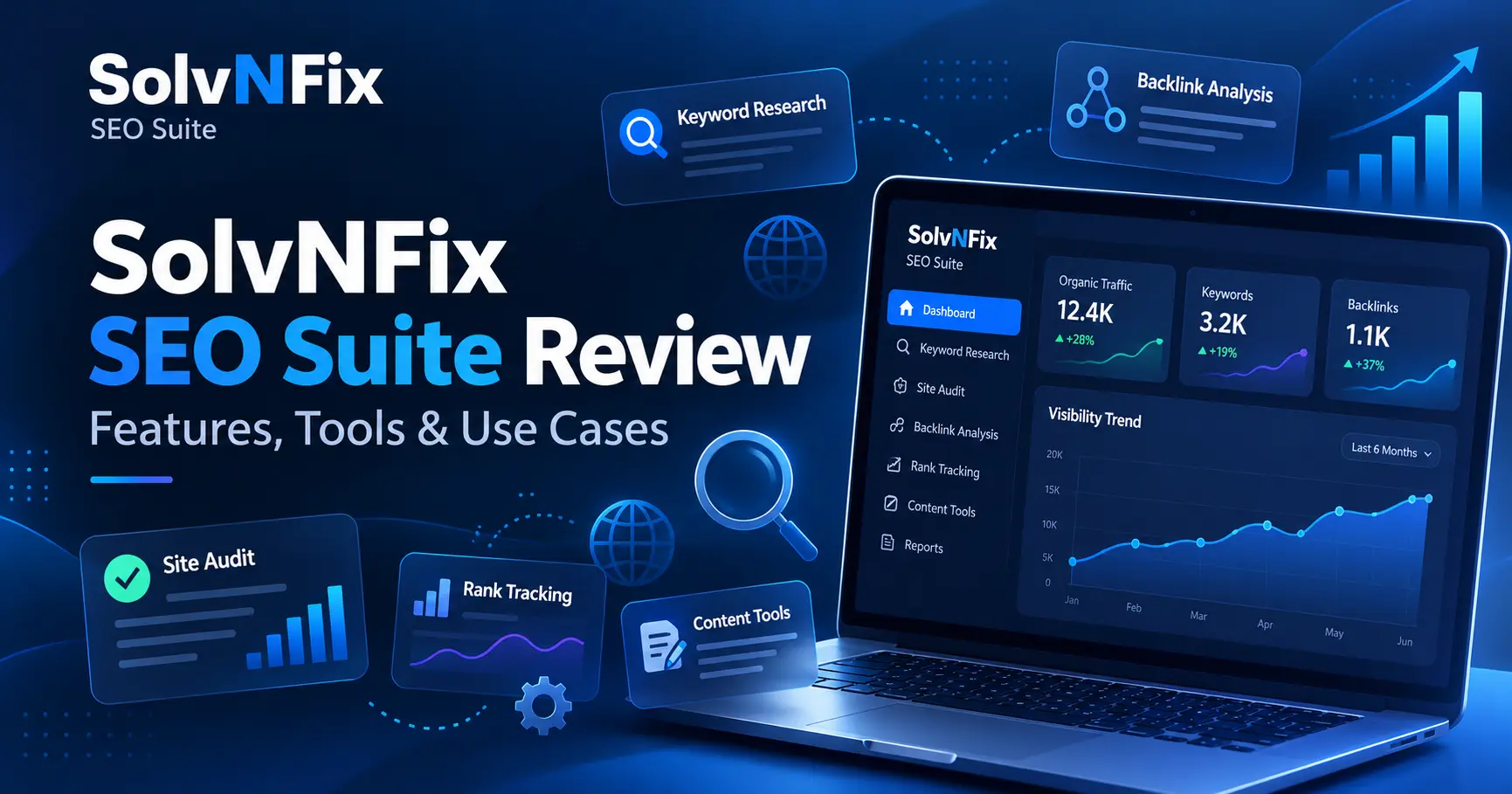
Rather than focusing on one specialist SEO function, it combines keyword research, competitive intelligence, backlink research, technical SEO and content optimization utilities within one subscription.
The important question, however, is not whether one platform can replace every specialist SEO product.
A more useful question is:
Can a consolidated toolkit make recurring SEO work easier to organize and more efficient?
That is the perspective from which this SolvNFix SEO Suite review evaluates the platform.
What Is the SolvNFix SEO Suite?
SolvNFix SEO Suite is the premium search-marketing section of the wider SolvNFix ecosystem.
Alongside its SEO offering, SolvNFix provides a collection of PDF, image, audio, video and general online utilities. The SEO Suite is aimed at users who require more advanced search-marketing capabilities.
According to the product information provided for this review, the suite brings together more than 40 SEO-related tools covering areas including:
- Keyword research
- Competitor analysis
- Backlink research
- Domain comparison
- Content-gap analysis
- Technical SEO auditing
- Indexability checks
- On-page optimization
- Content planning
- Rank and index monitoring
This breadth is relevant because SEO is usually a workflow rather than an isolated report.
A keyword opportunity becomes more useful when you can compare it with competing websites.
A technical problem becomes more actionable when you can connect it with crawlability, indexability and on-page recommendations.
Similarly, a content idea becomes more practical when related keywords can be clustered, mapped to search intent and developed into a usable content brief.
SolvNFix is therefore better understood as an SEO toolbox rather than a single-purpose SEO application.
Users can select the tools relevant to the task they are working on instead of being forced through one rigid workflow.
Keyword Research and Opportunity Discovery
Keyword research remains one of the foundations of organic search strategy.
SolvNFix includes tools designed for:
- Keyword opportunity research
- Long-tail keyword discovery
- Keyword-gap analysis
- Keyword clustering
- Search-intent analysis
- Question and People Also Ask discovery
Together, these tools can support several stages of the research process.
For example, a business could begin by identifying relevant search terms in its market, discover longer and more specific searches, compare its keyword coverage with competitors and then group related terms into useful content themes.
Search Intent Analyzer can help marketers consider why someone is searching, rather than evaluating keywords purely on volume.
Question and PAA research can also reveal informational subtopics that may deserve dedicated sections, FAQs or separate pages.
For agencies, this type of workflow can make keyword research easier to communicate to clients.
Instead of delivering a spreadsheet containing hundreds of disconnected keywords, opportunities can be organized around:
- Themes
- Search intent
- Content types
- Competitor gaps
- Potential landing pages
For an in-house marketer or publisher, the same process can help turn keyword research into a more structured editorial plan.
Competitor and Backlink Intelligence
SEO decisions are often more useful when considered within the competitive search landscape.
The SolvNFix SEO Suite includes tools such as:
- Organic Competition
- Domain Comparison
- Keyword Gap Analyzer
- Content Gap Finder
- Top Pages Analyzer
- Backlink Intelligence
- Site Backlink Finder
- Referring Domain Rank
Each tool addresses a different research question.
For example:
Which domains compete for similar organic visibility?
Which topics appear prominently across competitor websites?
Where do competing websites have keyword coverage that your site currently lacks?
Which competitor pages appear strategically important?
Which websites are linking to businesses in your market?
The suite also includes:
- Link Intersect
- Broken Backlink Finder
- Anchor Text Analyzer
- Guest Post Opportunity Finder
Used responsibly, these tools can assist with backlink research and outreach planning.
A broken backlink report, for instance, may reveal references to resources that no longer exist.
Link Intersect can highlight domains that link to several competitors but not your website, providing potential research opportunities.
However, backlink tools should never be interpreted as a recommendation to pursue every link they discover.
Relevance, editorial quality and context still matter.
The purpose of backlink data should be to help an SEO professional decide what deserves further investigation—not to automate link acquisition decisions.
Technical SEO and Website Auditing
Technical issues can prevent otherwise useful content from performing effectively in search.
SolvNFix includes several technical SEO utilities, including:
- Complete Website SEO Audit
- On-Page SEO Checker
- Technical SEO Scanner
- Indexability Checker
- Sitemap Analyzer and Generator
- Robots.txt Analyzer and Generator
- Schema Analyzer and Generator
- Redirect and HTTP Status Checker
- Broken Link Checker
- PageSpeed and Core Web Vitals tools
For small-business owners, technical SEO can quickly become difficult because of the terminology involved.
Bringing common checks into one environment can make the initial diagnostic process easier to manage.
For agencies and SEO consultants, the potential value is slightly different.
A consolidated toolkit can help create a more repeatable auditing workflow across multiple projects.
A sensible technical SEO sequence could look like this:
- Check crawlability and indexability.
- Review HTTP status codes.
- Examine redirects and broken links.
- Review XML sitemap configuration.
- Check robots.txt directives.
- Inspect important page-level SEO elements.
- Review structured data.
- Evaluate relevant performance signals.
The exact priority will vary from one website to another.
The important point is that a structured audit helps prevent SEO teams from treating every warning as equally important.
Content Planning and Optimization
Search visibility increasingly depends on publishing content that genuinely addresses the needs behind a query.
The SolvNFix SEO Suite includes content-focused utilities such as:
- SEO Content Optimizer
- Content Brief Generator
- Topical Map Generator
- Title and Meta Optimizer
- Content Refresh Finder
- Duplicate or Similarity Checker
- Internal Link Opportunity Finder
These tools can support both new and existing content.
When planning a new topic, a content team could use the suite to:
- Explore related keyword opportunities
- Organize them into clusters
- Understand likely search intent
- Develop a topical structure
- Create a content brief
- Refine page titles and metadata
For an established website, the workflow can shift toward optimization.
Teams can identify pages that may need updating, discover internal-link opportunities and investigate excessive similarity between pages.
This is especially relevant for publishers with large content libraries.
Older content can gradually become outdated, poorly connected to the rest of the website or less aligned with current search intent.
In many situations, improving an existing page can be more efficient than continuously creating new URLs.
The tools do not remove the need for editorial judgment.
They can, however, help identify where that judgment may be most useful.
How the SolvNFix Tools Can Connect in Real SEO Work
A feature list tells you what software contains.
A workflow tells you whether those features can actually be useful.
Consider a local business whose organic traffic has stopped growing.
An SEO consultant could begin with the Complete Website SEO Audit to establish a baseline.
The Indexability Checker and HTTP status tools could then be used to investigate obvious crawling or access problems.
Next, the consultant could compare the website with competing domains and use Keyword Gap or Content Gap analysis to identify missing topics.
Competitor pages could then be examined to understand which areas deserve closer investigation.
Keyword clustering and search-intent analysis could turn those findings into a smaller number of practical content projects.
After a page has been drafted, content and metadata tools could support the editorial review.
Internal-link research could help connect the new page with relevant existing content.
Backlink tools could then help the consultant understand which publications, websites or resources are active within that market.
Finally, rank or index monitoring can help determine whether a page is being discovered and whether its search visibility changes over time.
The value here is not any individual report.
It is the continuity between tasks.
One SEO question naturally leads to another while much of the research can remain within the same working environment.
What the SolvNFix SEO Suite Does Not Replace
An SEO toolkit should not be confused with an entire search-marketing operation.
SolvNFix does not remove the need for platforms and information sources such as:
- Google Search Console
- Website analytics
- Conversion data
- Customer research
- Sales information
- Editorial expertise
Google Search Console remains important for understanding how Google Search is interacting with a verified website.
Analytics platforms help connect acquisition with user behavior and business outcomes.
Customer interviews, sales conversations and first-party business data can reveal questions, objections and terminology that keyword tools may never fully capture.
The strongest approach is therefore complementary.
Use SEO software to research, diagnose, organize and optimize.
Use first-party platforms to validate what is actually happening on your website.
Then use human judgment to decide which opportunities and problems deserve priority.
That distinction matters when comparing SEO platforms.
The SolvNFix SEO Suite should be viewed as a broad operational toolbox—not as a promise that running an automated report will produce rankings.
Who Is the SolvNFix SEO Suite For?
The platform appears most relevant to users who need access to a broad range of day-to-day SEO functionality without building a large stack of separate subscriptions.
Potential users include:
- Freelance SEO professionals
- SEO consultants
- Digital-marketing agencies
- In-house content teams
- Publishers
- Small businesses
- Growing businesses
- Marketing teams managing multiple SEO activities
A specialist enterprise SEO department may still require dedicated platforms for specific datasets, large-scale crawling, reporting or specialized workflows.
That does not necessarily reduce the usefulness of a consolidated suite for users whose requirements are more operational.
The main value proposition is therefore breadth plus convenience: multiple commonly used SEO functions accessible through one environment and one subscription.
A Practical Way to Evaluate SolvNFix
The most useful way to judge any SEO platform is to test it against real work rather than opening individual tools without a clear objective.
Choose a website you already understand and take one SEO project through several stages.
Start with a site audit.
Identify meaningful technical and on-page issues.
Compare the website with two or three genuine organic competitors.
Look for keyword and content gaps.
Review backlinks and referring domains.
Choose one promising topic.
Cluster related search terms.
Analyze search intent.
Develop a content brief.
Finally, review internal-link opportunities, the page title and metadata.
This type of test tells you far more than simply browsing a feature list.
It shows whether the platform can support a connected SEO workflow and, more importantly, whether its outputs help you make useful decisions.
Want to evaluate the tools using one of your own websites?
Explore the SolvNFix SEO Suite through Digi Arun →
Usability and Value Should Be Tested Together
Software value is partly determined by how often a team actually uses the software.
A platform can contain hundreds of capabilities and still provide poor value if everyday tasks are difficult to locate or only one specialist understands how to use it.
When evaluating SolvNFix, consider both its output and its usability.
Ask questions such as:
Can a junior marketer complete a basic website audit?
Can a content editor move from keyword research to a usable brief without extensive training?
Can an agency repeat similar checks across several client websites?
Are the results understandable enough to turn into actions?
Rather than choosing a platform purely because of its price or feature count, determine whether it reduces enough friction in recurring SEO tasks to justify a permanent place in your workflow.
Current pricing and subscription terms should always be checked directly on the SolvNFix website before subscribing.
Questions to Ask During Your Evaluation
A useful SEO software trial or evaluation should end with clear answers.
Consider asking:
- Which tools became part of the normal workflow?
- Which reports resulted in an actual SEO action rather than simply producing more data?
- How quickly could a new user understand the interface?
- Did the suite reduce the need to move between unrelated platforms?
- Were the findings useful enough to support client or internal SEO decisions?
- Which features would you realistically use every week?
These questions keep the evaluation focused on practical value.
The right SEO platform is not automatically the one with the longest feature list.
It is the one your team can use repeatedly to make better-informed decisions with less unnecessary friction.
Final Perspective: Is SolvNFix SEO Suite Worth Exploring?
SolvNFix SEO Suite is built around a straightforward idea: SEO professionals often need access to a wide range of functions, but they may not want to maintain an equally wide range of software subscriptions.
Its collection of more than 40 SEO-related tools covers many recurring activities involved in:
- Keyword research
- Competitor analysis
- Backlink research
- Technical SEO
- On-page optimization
- Content planning and optimization
- Rank and index monitoring
Its strongest potential fit is likely to be freelancers, consultants, agencies, publishers and growing businesses that value having multiple SEO utilities within the same working environment.
That breadth should still be combined with first-party analytics, Google Search Console, business data and professional judgment.
Used in that way, SolvNFix can function as a central workspace for investigating opportunities, diagnosing SEO problems and turning research into an actionable plan.
If that matches the way you work, the most sensible next step is not to rely on a feature list alone—test the tools against a website and SEO workflow you already know.
Explore the SolvNFix SEO Suite with Digi Arun →
Affiliate disclosure: The link above is a Digi Arun partner link. Digi Arun may receive a commission if you purchase through it, at no additional cost to you.
About SolvNFix
SolvNFix is an online tools ecosystem offering PDF, image, audio, video and general utility tools alongside premium SEO and AI-focused products.